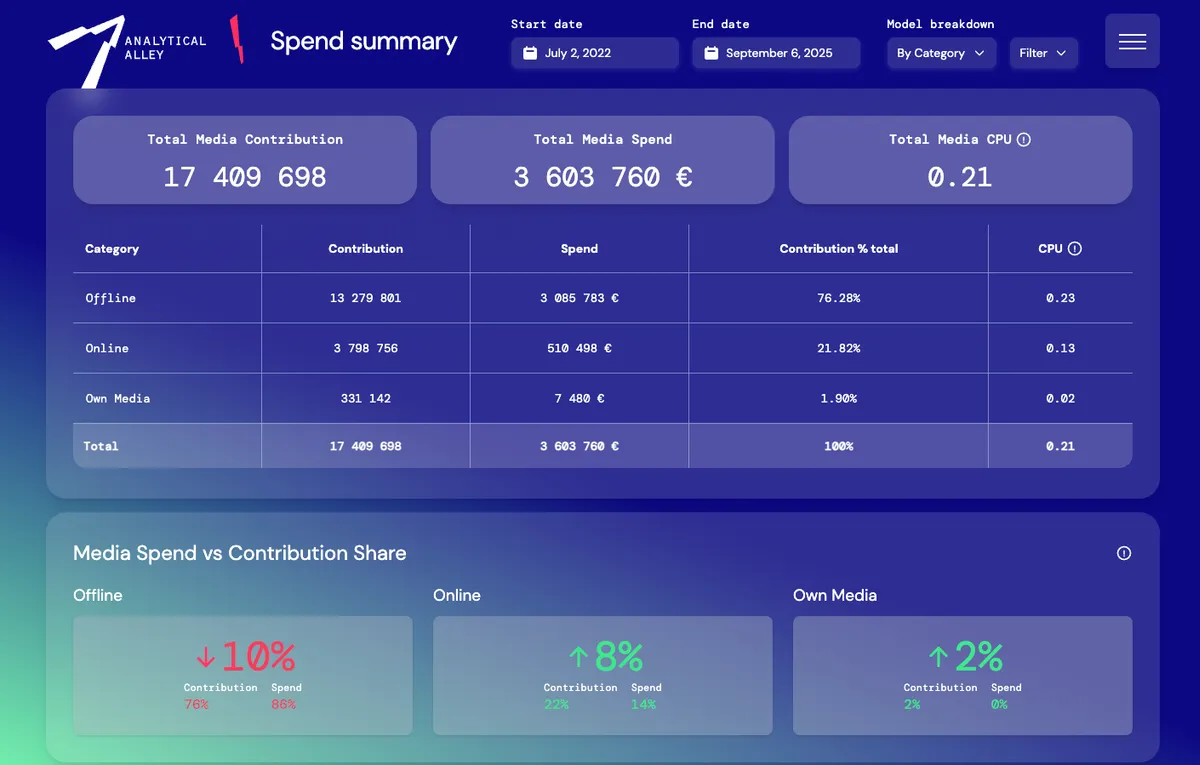
Most B2C marketers can't prove their content drives revenue. You publish blog posts, produce videos, and distribute case studies, yet when the CFO asks for ROI, you point to engagement metrics and hope they satisfy. They don't. Eighty-two percent of businesses use content marketing, but traditional measurement systematically understates its value by 30–60% in European markets constrained by GDPR and iOS ATT. Econometric approaches solve this by isolating content's true incremental contribution across the customer journey.
Content marketing ROI quantifies the revenue generated by your content investments relative to what you spent creating and distributing that content. The basic formula is:
Content Marketing ROI = (Revenue Attributed to Content – Content Investment) / Content Investment × 100
Yet this calculation masks measurement challenges unique to content. Unlike paid search where a click precedes conversion within minutes, content builds awareness over weeks before driving action. A prospect reads your blog post today, watches a video next week, and converts thirty days later through organic search. Platform analytics assign credit to the last touchpoint, systematically undervaluing everything that came before.
Econometric approaches solve this by modeling content's contribution at an aggregate level. Rather than tracking individual user journeys through degraded cookie signals, marketing mix modeling uses regression to isolate how content spend drives incremental sales while controlling for seasonality, promotions, competitor activity, and other marketing channels. The output tells you exactly how much revenue each euro of content investment generates, net of everything else influencing your business.
Google Analytics and social dashboards report attributed conversions, not incremental impact. This creates two systematic errors that penalize content marketing.
First, platform attribution captures only a fraction of content's influence. In GDPR-compliant markets, platforms miss 30–60% of actual marketing impact due to cookie restrictions and iOS App Tracking Transparency. When a prospect views your video on LinkedIn, reads your case study three weeks later via email, and converts through branded organic search, traditional measurement credits none of it to content. The conversion appears organic, masking the awareness and consideration work your content performed.
Second, short attribution windows cut off long-term effects. Video content drives 20% increases in website traffic and 13% increases in purchase intent, yet standard seven-day or thirty-day windows exclude conversions that occur months after exposure. Marketing effects persist 12–16 weeks in many consumer categories, far beyond typical measurement windows. When you publish an evergreen blog post that ranks and drives traffic for eighteen months, measuring only the first thirty days captures perhaps 5% of total value.
Content operates in awareness and consideration stages where influence is indirect and delayed. A prospect discovers your brand through a blog post indexed in Google, engages with a whitepaper distributed via email, shares a video on social media, and eventually converts through a remarketing ad. Platform analytics see the final click but miss the content journey that made conversion possible. The remarketing ad gets full credit; the content that built awareness and intent gets zero.
Marketing mix modeling provides the mathematical framework to quantify content's true contribution. The approach builds a regression model that explains sales as a function of all marketing inputs, external factors, and baseline trends:
Sales = β₀ + β₁(Content Spend) + β₂(Paid Media) + β₃(Email) + β₄(Seasonality) + β₅(Promotions) + ε
The coefficient β₁ tells you content's incremental impact. For example, a β₁ of 2.3 means every euro invested in content generates €2.30 in incremental revenue, isolated from other channels and external factors that would have driven sales regardless. This is causal measurement, not correlation.
Two transformations make these models realistic for content marketing. Adstock effects capture content's carryover impact. Blog posts continue driving traffic months after publication. A video viewed today influences brand perception for weeks. The adstock formula models this decay:
Adstock_t = Content Spend_t + (λ × Adstock_t–1)
Where λ represents the carryover rate. Content typically shows higher carryover than performance channels. Video content might use λ = 0.5–0.7, meaning 50–70% of this week's impact carries into next week. Blog content can show even longer decay, with λ = 0.6–0.8 as evergreen pieces continue generating organic traffic indefinitely. These decay parameters are estimated from your data, not assumed.
Saturation curves model diminishing returns as content spend increases. The first €10,000 invested in content creation generates more incremental return than the next €10,000. The Hill transformation captures this:
Effect = Spend^α / (K^α + Spend^α)
Where K represents the half-saturation point and α controls how steeply returns diminish. This prevents models from unrealistically recommending infinite content budgets and helps you find the optimal investment level where marginal returns equal your cost of capital.
Different content formats deliver varying returns. Blog posts generate approximately 15% ROI on average, while images deliver 22% and case studies return 15%. Yet these figures represent broad averages across industries and ignore the compounding value of content libraries. A blog post published today might deliver 15% ROI in year one, then 8% in year two as organic traffic compounds, and another 5% in year three as backlinks accumulate. The true lifetime ROI is 28%, not 15%.
Email marketing demonstrates content's power when properly measured. Email brings in €36 for every €1 spent, representing a 3,600% ROI. This performance reflects email's dual role as both distribution channel and content vehicle. Fifty-nine percent of consumers state marketing emails influence purchase decisions. European B2C brands achieve these results through segmented, personalized content that speaks directly to subscriber needs rather than generic promotional blasts.
Video content warrants particular attention. Ninety-three percent of marketers claim video marketing ensures good ROI, and when measured through econometric models with appropriate 14–28 day attribution windows, video typically shows 100–250% ROI. Domino's identified a 45% increase in overall ROI after running brand awareness campaigns concurrently with performance campaigns on YouTube, demonstrating measurable synergies between content and direct response efforts. The brand campaign amplified the performance campaign's effectiveness by increasing consideration before the click.
Influencer marketing shows the widest variance, with ROI ranging from –20% to over 400%. The low performers typically measure only last-click conversions, missing the awareness impact that influencer content creates. When measured econometrically to capture consideration effects, mid-tier and micro-influencer campaigns often outperform macro-influencer partnerships. Audio advertising grew 33% and influencer marketing 30% in Germany between 2022 and 2024, driven by improved measurement capabilities that justified increased spend.
Measuring content ROI requires combining multiple data sources and measurement approaches. Organizations that master this process make smarter allocation decisions and generate 40% less wasted spend. Here's the step-by-step process.
Implement comprehensive tracking infrastructure. Server-side tracking forms the foundation as browser-based tracking degrades. Server-side implementations capture content interactions that cookies miss, recovering 20–40% of lost conversions in privacy-restricted environments. Tag every content asset with proper UTM parameters that specify channel, content type, campaign, and creative. Structure your taxonomy to enable analysis by format (blog, video, case study) and topic cluster so you can identify which themes resonate.
Centralize data from content platforms, your CMS, email tools, social channels, and CRM into a single warehouse. This unified view lets you connect content exposure measured in one system to downstream conversion and revenue tracked in another. Without centralization, you're measuring fragments rather than the full customer journey.
Calculate margin-based content ROI. Revenue-based ROI calculations mislead because they ignore gross margin differences across products and customer segments. A content campaign generating €100,000 in revenue at 30% margin costs €20,000 to produce. The true margin-based ROI is:
Content ROI = (€30,000 – €20,000) / €20,000 × 100 = 50%
While a naive revenue calculation would show 400% ROI, the margin-based figure reveals actual return after accounting for cost of goods sold. For subscription or repeat-purchase businesses, extend this calculation to include customer lifetime value over 12–24 months. A piece of content that acquires a customer with 18-month LTV of €800 at 40% margin delivers €320 in lifetime profit contribution, dramatically exceeding first-order revenue.
Set appropriate attribution windows by content type. Different content formats require different measurement windows because their influence patterns differ. Use these guidelines as starting points, then refine based on your data:
Shorter windows understate impact by cutting off delayed conversions. Longer windows risk over-attribution as other touchpoints intervene and influence shifts to newer marketing efforts.
Build an econometric content model. For organizations investing €5,000–€10,000 monthly in content (the typical range for 58% of companies across industries), a basic MMM becomes viable and cost-effective. You need 18–24 months of historical data at weekly or monthly granularity, content spend broken out by format where possible, sales or conversion data, other marketing channel spend, and relevant control variables such as seasonality, promotions, and pricing changes.
The model isolates content's incremental contribution by controlling for everything else happening in your business. A properly specified model achieves R² greater than 0.8, explaining over 80% of sales variation. Organizations using this approach can predict outcomes with over 90% accuracy, transforming marketing from art to science.
The model produces three critical outputs. Absolute contribution shows total revenue generated by content investment. Average ROI reflects overall return across all content spend. Marginal ROI indicates return on the next euro of content investment and guides optimization decisions. If your current content budget shows 200% average ROI but only 80% marginal ROI, additional spend produces diminishing returns and should be redirected. Conversely, high marginal ROI (300%+) signals you're under-investing relative to opportunity.
Validate with incrementality tests. Econometric models make assumptions about functional forms, lag structures, and variable relationships. Validate outputs with controlled experiments that measure true incrementality. The most practical approach for content is geo-holdout testing.
Select matched pairs of geographic markets based on similar sales patterns, demographics, and baseline trends. In one set, maintain your current content strategy. In the holdout markets, reduce or eliminate specific content channels for 4–8 weeks. Measure the sales difference between treatment and control groups, then reconcile with your MMM predictions.
Example: Your MMM predicts content drives 250% ROI. A geo test measures 180% ROI. The 70-percentage-point gap suggests your model over-estimates content impact, prompting recalibration of decay parameters or saturation assumptions. Conversely, if the geo test shows higher ROI than MMM, your model may be under-attributing value to content because it's omitting important interaction effects or using too-short carryover windows.
Account for content synergies. Content rarely operates in isolation. Blog posts drive organic traffic that converts via paid search branded terms. Videos boost consideration, making retargeting more effective by warming cold audiences. Case studies enable sales teams to close deals faster by answering objections preemptively. These synergies create compounding value that simple additive models miss.
Model interactions explicitly by including cross-channel terms in your regression. A content × paid search interaction coefficient of 1.3 means every euro of content spend makes paid search 30% more effective through increased branded search volume and higher quality scores. Understanding synergies prevents destructive budget cuts. Reducing content to fund more paid search can paradoxically decrease paid search performance by eroding the awareness foundation that makes search efficient.
Optimize allocation across content formats. With incremental ROI estimated by content type, you can optimize your content mix mathematically. The principle is simple: reallocate budget toward formats with higher marginal ROI until marginal returns equalize across all content types.
If video shows 300% marginal ROI while generic blog posts show 120%, shift resources toward video production. Increase video budget incrementally, perhaps by 20% initially. After reallocation, video ROI will decline as you move down its saturation curve while blog ROI improves as reduced spend moves you back up the steeper part of its curve. Continue reallocating until marginal returns converge. The optimal allocation equalizes marginal ROI across all content formats, maximizing total revenue given your overall content budget constraint.
Treating all attributed conversions as incremental. Content that appears before a conversion in the user journey isn't necessarily causing that conversion. Someone searching your brand name would likely convert whether they saw your blog post or not. They already have intent; the content is simply present in the journey. Econometric measurement controls for this by isolating incremental impact above baseline sales that would occur without content marketing.
Research shows 60–80% of brand search conversions would have happened organically even without paid or content marketing driving awareness. When you attribute them all to content that mentions your brand, you overstate ROI by three to five times. The correction comes from properly modeling baseline sales and estimating content's lift above that baseline rather than taking raw attributed conversions at face value.
Ignoring fixed content costs. Many organizations exclude salaries, tools, and infrastructure from content ROI calculations, counting only direct production costs like freelance writing fees or video production budgets. This dramatically inflates ROI because you're omitting 40–60% of true costs. Include the fully loaded cost of your content team (salary, benefits, taxes), CMS licensing, production tools, stock assets, agency retainers, and distribution costs. Only then do you have an honest assessment of whether content investment beats alternative uses of that capital.
Using revenue ROI instead of margin ROI. Revenue-based calculations ignore profitability differences across products and customer segments. Content driving €100,000 in low-margin revenue (say 20% gross margin, yielding €20,000 contribution) may be less valuable than content generating €60,000 in high-margin sales (50% margin, yielding €30,000 contribution). Always calculate ROI using gross profit contribution rather than revenue to avoid optimizing for top-line vanity metrics at the expense of bottom-line performance.
Short-term measurement for long-term content. Evergreen content builds value over years. A comprehensive guide published today continues driving traffic, generating leads, and influencing purchases for 12–18 months. Thirty-nine percent of marketing specialists report it takes one to two months to rank with AI-generated content, and organic traffic compounds from there as backlinks accumulate and domain authority grows. Measuring only the first 30 or 60 days misses 80–90% of the value that evergreen assets create. Use lifetime-value calculations for evergreen content rather than short attribution windows designed for performance campaigns.
Averaging ROI over time. Computing a single average ROI across all time periods masks recent changes in performance. Your content strategy six months ago may have delivered 300% ROI, but shifts in content quality, increased competition for rankings, algorithm changes, or audience fatigue could have degraded current performance to 150%. Track rolling 90-day ROI alongside cumulative figures to spot deterioration early. When rolling ROI drops below your threshold, investigate root causes before performance craters further.
Seventy percent of marketers using AI for advanced personalization have earned 200% ROI or more, and marketers report an average 68% increase in ROI when using AI tools for campaigns. These gains come from three applications that improve content efficiency without requiring proportional budget increases.
Predictive content recommendations use machine learning to match content to user context, interests, and position in the buying journey. Rather than showing all visitors the same homepage blog feed, predictive engines surface the most relevant content for each prospect based on referral source, browsing behavior, firmographic data, and past engagement patterns. This increases engagement rates 40–60% and improves conversion rates by personalizing the journey without creating unique content for each microsegment.
AI-assisted content creation accelerates production while maintaining quality standards. Tools generate first drafts that human editors refine, optimize headlines through multivariate testing, suggest internal links based on semantic similarity, and adapt tone to audience segments. This efficiency gain means the same content budget produces 30–50% more assets. More content means more ranking opportunities, more email sequences, more social distribution, and ultimately more touchpoints across the customer journey that improve overall marketing effectiveness.
Dynamic personalization adapts content in real-time based on visitor behavior, referral source, device type, and known preferences stored in your CRM. An email subscriber arriving from a paid social campaign sees different content variations than an organic visitor, optimizing relevance and conversion probability. The homepage hero, featured case studies, product recommendations, and calls-to-action adjust automatically. This eliminates the need to create separate landing pages for every audience segment while achieving similar personalization benefits.
The Germany digital content creation market generated USD 1,235.2 million in 2024 and is expected to reach USD 2,650.1 million by 2030, growing at 13.8% CAGR. This growth reflects both increased content investment and improved technology that makes personalization scalable for mid-market and enterprise B2C brands that previously couldn't afford bespoke content strategies.
Your content measurement approach should match your organization's scale and sophistication. Premature investment in advanced measurement wastes resources; delayed investment leaves money on the table through suboptimal allocation.
Early-stage organizations (under €5M revenue): Use platform analytics and attribution reports as directional guides rather than precise measurements. Calculate simple content ROI using gross margin and direct costs. Focus infrastructure effort on building consistent tracking and accumulating historical data that will enable econometric modeling later. MMM requires at least 100 conversions per week to produce stable coefficient estimates, which many early-stage businesses don't yet generate. Invest in tracking taxonomy and data centralization so you're ready to model when volume crosses the threshold.
Growth-stage businesses (€5–20M revenue): At this scale, content budgets of €5,000–€10,000 monthly justify basic MMM. Run annual or biannual models to understand content's incremental contribution across formats and themes. Complement econometric insights with platform analytics for tactical optimization of headlines, posting times, and audience targeting. Use quarterly geo-holdout tests to validate model outputs and build stakeholder confidence in measurement accuracy. Organizations at this stage can reduce wasted ad spend by 40% through disciplined measurement that reallocates budget from low-ROI to high-ROI content types.
Mature enterprises (€50M+ revenue): Run continuous MMM with monthly refreshes as new data becomes available. Integrate content measurement with marketing mix optimization across all channels to find the global optimum rather than local maxima within content alone. Build scenario-testing capabilities that simulate content strategy changes before implementation, answering questions like "What happens if we shift 30% of blog budget to video?" before committing resources. Embed content ROI metrics in executive dashboards alongside digital marketing KPIs and planning cycles so optimization becomes continuous rather than episodic.
The maturity path is progressive. Start where measurement is tractable given your data and resources. Each improvement in measurement quality enables better optimization, which generates higher ROI that funds more sophisticated measurement infrastructure. The compounding returns from better decisions dwarf the measurement investment within 6–12 months.
Pure performance content (comparison pages, product reviews, conversion-focused landing pages) generates immediate measurable returns. Brand content (thought leadership, storytelling, values-driven content) builds longer-term awareness and affinity that amplifies all marketing. The tension between these two content strategies reflects a deeper strategic question about time horizons and growth sustainability.
Research recommends allocating 50–60% of marketing budgets to brand-building activities with 40–50% on performance tactics. This balance applies to content strategy as well. Over-indexing on performance content produces quick wins but neglects the awareness foundation that makes performance content effective. Prospects who've never heard of your brand don't convert on your comparison page regardless of how optimized the copy is. You need brand content to fill the top of funnel before performance content can convert at the bottom.
Econometric measurement quantifies this balance by modeling both content types. You can observe how brand content lifts performance content effectiveness through cross-channel interaction terms. When you measure marketing effectiveness holistically, you find that a 1% increase in brand awareness drives 0.4% short-term sales increase and 0.6% long-term growth. Brand content creates this awareness, generating compounding returns that short-term measurement misses entirely.
Digital marketing in Germany creates over 22 billion euros in added value annually, with balanced strategies driving sustainable growth. Organizations that shift entirely toward performance optimization sacrifice brand health for short-term conversion spikes, ultimately degrading both metrics as brand awareness declines. The optimal strategy maintains the 60/40 brand-to-performance ratio and uses econometric measurement to fine-tune within that constraint rather than abandoning one pole completely.
If you're not measuring content ROI systematically, start with these concrete steps prioritized by time horizon and implementation difficulty.
Immediate action (this week): Audit your current content tracking infrastructure. Ensure every piece of content published from this point forward includes proper UTM parameters that specify source, medium, campaign, and content format. Export twelve months of content spend (including salaries and tools), production costs, and attributed conversions to calculate a baseline blended ROI. This establishes your starting point and provides a benchmark against which to measure improvement.
Short-term priorities (this quarter): Implement server-side tracking if you haven't already to recover 20–40% of lost conversions in privacy-restricted environments. Calculate margin-based ROI by content format (blog, video, email, case study, social) to identify which types deliver the strongest returns given your business model and customer LTV. Run one geo-holdout test on your highest-spend content channel to measure incremental impact and validate platform attribution reports. The gap between platform reports and geo-test incrementality will reveal how much you've been over- or under-valuing that channel.
Medium-term goals (next six months): Build or commission a basic marketing mix model that includes content as a distinct variable alongside paid media, email, and other channels. Ensure the model includes appropriate adstock and saturation transformations for content formats. Use the outputs to reallocate budget toward higher-performing content formats, shifting perhaps 15–20% of spend in the first iteration. Set quarterly review cycles to track whether changes improve overall ROI and refine allocation based on updated coefficient estimates.
Long-term capability (next 12–24 months): Integrate content measurement into strategic planning processes so optimization becomes proactive rather than reactive. Use econometric models to simulate different content strategies before committing budget, answering questions about optimal blog-to-video ratios, influencer partnership value, and evergreen-versus-timely content trade-offs. Build cross-functional alignment between marketing, finance, and executive teams around margin-based ROI as the primary success metric, replacing engagement metrics and attributed conversions in performance reviews and bonus calculations.
The goal isn't perfect measurement. Perfect measurement is impossible because marketing operates in noisy real-world environments with imperfect data, confounding variables, and constantly shifting competitive dynamics. The goal is progressively better decisions that compound over time. Each improvement in measurement quality enables smarter content investments, higher ROI, and stronger business impact. A 10% improvement in allocation quality repeated quarterly produces 46% cumulative improvement over two years through compounding.
Organizations that measure content marketing through an econometric lens consistently outperform those relying on platform attribution. They waste less budget on low-return content formats, invest more in high-impact types, and optimize the mix to maximize total return. The difference between vague directional metrics and precise incrementality measurement is the difference between hoping content works and knowing it works.
Analytical Alley's mAI-driven media strategy combines AI computing power and human insight to guide marketers toward smarter content decisions through marketing mix modeling that predicts outcomes with over 90% accuracy. By analyzing all factors across product, media, and macro variables, you can finally quantify content's true contribution and optimize your mix with confidence rather than intuition. Book a consultation to discover how econometric measurement transforms content marketing ROI from a mystery into a strategic lever for growth.