Digital marketing analytics: a complete guide for B2C marketers

December 2, 2025

Digital marketing analytics costs European organizations billions in wasted spend every year. Nearly half of all advertising budgets leak revenue through poorly allocated campaigns, yet marketing mix modeling demonstrates that econometric methods can predict outcomes with over 90% accuracy and slash ad waste by up to 40%.

What digital marketing analytics means in B2C econometrics

Digital marketing analytics for B2C econometrics involves the collection, analysis, and interpretation of data from multiple marketing channels using advanced econometric methods to understand how various inputs contribute to customer behavior and incremental sales. Unlike basic tracking and reporting, modern analytics integrates sophisticated econometric models with mAI-driven insights to measure the interplay of mass media, digital channels, and macroeconomic variables.

The discipline has evolved beyond simple conversion tracking. Today's marketing strategists use statistical rigor and machine learning to analyze digital marketing performance, providing a single customer view that is especially critical for online sales activation. This approach distinguishes base sales (what would occur without marketing) from incremental sales directly attributable to specific campaigns.

Why econometric measurement matters more than attribution

Traditional attribution models suffer from "attribution myopia" by measuring correlation rather than causation. A study where TV campaigns were undercounted by 60% in attribution models but shown to be highly impactful through econometrics demonstrates this critical gap.

Econometric modeling uses time-series data and macroeconomic factors to isolate the incremental uplift of marketing activities. For example, it can analyze how TV advertising, social media campaigns, and seasonal promotions interact to drive sales, revealing that TV ads often have a longer-lasting impact on brand awareness, while social media campaigns prove more effective for immediate conversions.

Consider a scenario where your Facebook ads show a 4:1 ROAS in platform attribution. If €25,000 of the €40,000 attributed revenue would have occurred anyway (customers who were already planning to purchase), your true incremental ROAS is only 1.5:1. This distinction determines whether you should scale or cut investment.

Essential KPIs for B2C marketing performance

Effective digital marketing KPIs span four critical measurement layers that translate econometric models into actionable strategies.

Customer acquisition cost (CAC) tracks total spend divided by new customers acquired. More importantly, incremental CAC measures the cost of additional customers gained through increased spend. If you increase Facebook spend by €10,000 and acquire 50 additional customers (not just attributed customers), your incremental CAC is €200.

Conversion rate tracks the number of visitors who take action. A 2% conversion rate means 2 out of 100 visitors convert. Increasing CVR from 2% to 2.5% effectively reduces your CAC by 20%, making this metric a powerful lever for optimization.

Customer lifetime value (CLV) represents the total value a customer brings over time. For instance, €50 per order multiplied by 10 purchases equals €500 CLV. Econometric analysis often reveals that customers acquired through brand-awareness campaigns have 30% higher CLV than those from direct-response channels, justifying different CAC thresholds.

Repeat purchase rate and average order value (AOV) directly impact CLV. German hookah brand Moze increased both AOV and CVR by implementing econometric-driven cross-sell and upsell recommendations. The key insight: a customer who purchases four times over two years effectively reduces your CAC to one-quarter of the initial acquisition cost per transaction.

Return on investment (ROI) must distinguish between attributed and incremental returns. Platform attribution, often Return on as spend(ROAS), consistently inflates results because it credits campaigns for sales that would have occurred organically. Marketing mix models quantify true incrementality, enabling comparisons like: "For every €1 spent on digital advertising, we see a €1.50 return in incremental sales."

Marginal ROI matters more than average ROI for allocation decisions. Your first €10,000 in paid search might generate €40,000 in incremental revenue (4:1 ROAS), but the next €10,000 might only yield €25,000 (2.5:1) due to saturation. Econometric models with saturation curves reveal these diminishing returns to guide optimal spend levels.

Market share and share of voice predict future performance. When your share of voice exceeds market share by 10 percentage points (an "excess share of voice"), expect a 1-2 percentage point market share gain over the next year. With the German B2C e-commerce market projected to grow from $58.4 billion in 2023 to $88.4 billion by 2028, even small share gains translate to significant revenue.

Core marketing mix modeling methodology

Marketing mix modeling is a sophisticated econometric approach that quantifies marketing activities' impact on sales and revenue using statistical methods like multi-linear regression and adstock transformations. The fundamental equation decomposes sales into components:

Sales = Base + Marketing Effects + Control Effects + Error

Base sales represent what you would achieve with zero marketing, driven by long-term trends, brand strength, pricing, and market conditions. Marketing effects capture the incremental contribution from each channel after applying realistic transformations. Control effects model external influences like seasonality, weather, and competitor actions.

Adstock transformations model the delayed and carry-over effects of advertising. TV campaigns often peak in effectiveness two weeks after airing, while digital display maintains effects for shorter periods. The mathematical formulation (Adstock_t = Spend_t + θ × Adstock_(t-1)) with typical θ ranges of 0.1-0.4 for digital and 0.4-0.8 for TV captures these dynamics.

Saturation curves represent diminishing returns as spend increases. A Hill saturation curve (Effect = Spend^α / (K^α + Spend^α)) models how the first €10,000 in a channel generates more incremental sales than the next €10,000. Econometric analysis can show that paid search saturates beyond €50,000 per month, making additional investment inefficient.

A CPG brand using these methods found digital ads drove 15% more incremental sales per dollar than TV ads, leading to a 30% budget reallocation toward digital channels and substantial ROI improvement.

Robust marketing mix modeling data science requires at least 18 to 24 months of historical data with weekly granularity. Essential inputs include spend across all channels (ideally campaign-level), consistent KPI measurement, media delivery metrics (impressions, reach, GRPs), and external variables like pricing, promotions, weather, and competitor activity.

Model validation ensures reliability through multiple checks. R-squared values typically exceed 0.8 for strong models (though values above 0.95 suggest overfitting). Mean Absolute Percentage Error (MAPE) below 5% indicates excellent accuracy, 5-10% is good, and above 15% signals problems. Out-of-sample validation using chronological train/holdout splits confirms the model generalizes to new periods.

Calibration to incrementality tests provides ground truth. If Facebook conversion lift studies consistently show 1.5:1 to 2.5:1 ROI, those results can serve as Bayesian priors to improve model estimates and constrain them to realistic ranges.

Predictive analytics applications for B2C

Predictive analytics in B2C marketing uses historical data, statistical algorithms, and machine learning techniques informed by econometric principles to forecast future outcomes. This enables tailored messaging and advertising optimization rather than just descriptive reporting.

Marketing mix models enable simulation of different spending plans before committing resources. You can answer questions like: "If we increase search spend by 30% and reduce social by 15%, what happens to revenue?" One FMCG brand reported gains of over €15 million after reallocating budget based on predictive insights from econometric modeling.

Optimal budget allocation equalizes marginal ROI across channels. If paid search delivers €4 incremental revenue per additional euro at current spend while social delivers €6, reallocate toward social until diminishing returns bring the channels into balance. Mobile app clients have achieved 75% lower customer acquisition costs and 25% higher conversion rates using these MMM insights.

Bayesian predictive intervals provide realistic confidence bounds. Rather than claiming "we forecast €5.2M in revenue," sophisticated models report "we forecast €5.2M with 90% probability it falls between €4.8M and €5.6M." This uncertainty quantification helps risk-averse CFOs and CEOs understand the range of possible outcomes.

When plans diverge significantly from historical patterns (new product launches, major creative changes), adjust confidence intervals wider to reflect additional uncertainty and consider sensitivity analyses that vary key assumptions by ±20%.

Cross-channel synergies and interaction effects

Econometric models reveal how channels work together rather than in isolation. Display advertising effectiveness research demonstrates that digital display ads increase site visits by 17% and conversions by 8%, with post-campaign effects sustaining brand awareness after the campaign ends.

TV and digital synergies amplify performance. Boots UK observed a significant improvement in paid search performance when running campaigns alongside TV. The awareness generated by TV creates demand that digital channels convert more efficiently. Ignoring these synergies when reallocating budgets can be counterproductive; cutting TV might reduce overall performance even if TV's direct attributed return appears low.

A meta-analysis of 432 field experiments with over 2.2 billion observations found that YouTube advertising drives a 20% increase in website traffic and 13% increase in purchase intent in B2C environments according to Google and Ipsos research. When integrated properly into the marketing mix through econometric modeling, YouTube delivers cost-effective engagement with average cost-per-view ranging from $0.10 to $0.30 compared to TV CPMs of $20 to $30.

Practical implementation for marketing teams

Implementing econometric measurement requires both technical infrastructure and organizational capability. Different roles leverage these insights in complementary ways.

Marketing strategists and media buyers use marketing mix modeling software to run continuous what-if scenarios and identify optimization opportunities. A retailer reduced full-price sales cannibalization by 12% while maintaining revenue growth through MMM-driven promotion optimization.

Set up monthly optimization cycles: refresh models with latest data, generate channel-level ROI and marginal ROI reports, identify reallocation opportunities where marginal returns differ by more than 20%, and implement gradual shifts (10-15% reallocations) rather than dramatic changes.

Track both attributed metrics (for tactical optimization within channels) and incremental metrics (for strategic allocation across channels). The hybrid approach uses MMM for cross-channel decisions and multi-touch attribution for granular digital optimization like creative testing and keyword selection.

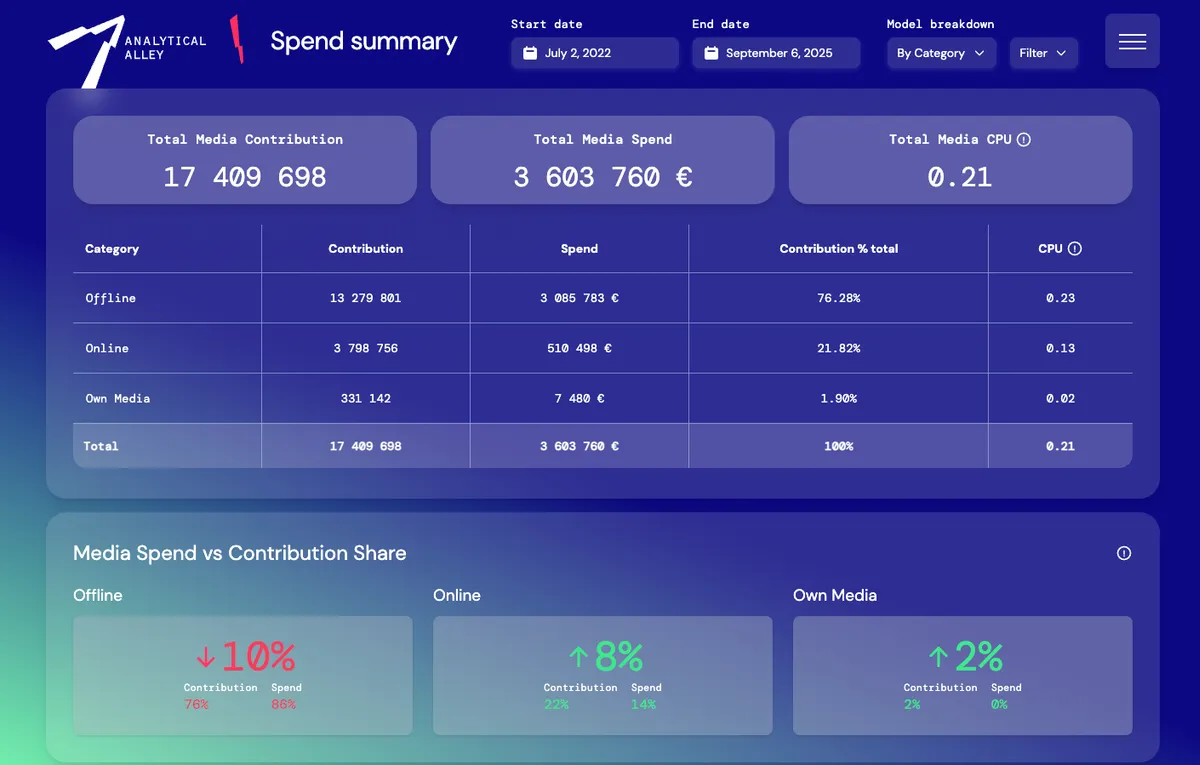
Marketing mix modeling provides the financial accountability senior leaders require. Rather than defending channel spend based on platform-reported metrics, present econometric evidence like: "Marketing generated €12M in incremental revenue this quarter, delivering a 3.2x ROI. TV awareness campaigns lift digital conversion rates by 23%, demonstrating the importance of integrated channel strategy."

O2's econometric analysis found that reducing churn repaid media budget nearly four times over, shifting strategic focus from acquisition to retention. This type of insight aligns marketing investment with long-term business value rather than short-term conversion proxies.

Documentation of successful social campaigns demonstrates how econometrics-driven approaches deliver measurable business outcomes. John Lewis Insurance isolated a halo effect where "for every £1 spent on insurance advertising, John Lewis saw an additional £0.50 in non-insurance related sales," quantifying brand spillover effects that pure attribution misses.

CEOs evaluating marketing effectiveness should focus on three strategic questions econometric measurement answers: What percentage of sales and revenue comes from marketing versus brand equity, pricing, and distribution? Which channels deliver the highest incremental return at current spend levels, and where are we approaching saturation? How do our investments balance short-term sales activation with long-term brand building?

Typical B2C brands see marketing account for 30-60% of sales, with baseline (non-marketing) factors driving 40-70%. Nielsen research shows a 1% increase in brand awareness produces a 0.4% short-term sales lift and 0.6% long-term increase, justifying sustained brand investment.

Integration with modern marketing technology

Marketing mix modeling works alongside, not instead of, your existing analytics stack. Integration with attribution platforms, Google Ads, Facebook Ads Manager, and TikTok provides the granular data inputs that enable greater than 90% prediction accuracy.

Privacy compliance makes econometric methods increasingly valuable. MMM is GDPR and ATT-compliant because it doesn't rely on cookies or personal data. With over 50% of marketers expected to increase MMM usage by 2025 due to cookie deprecation, econometric measurement future-proofs your analytics infrastructure.

Modern platforms combine statistical rigor with practical usability. Automated data pipelines collect daily spend and sales data, while monthly model refreshes incorporate new information without requiring full rebuilds. Alert systems trigger when actual performance deviates from predictions by more than 10% for two consecutive weeks, enabling rapid course correction.

Getting started with econometric analytics

Most B2C organizations can begin implementing econometric measurement within three to six months. The typical implementation roadmap includes data collection and preparation in months one and two: audit existing data sources, establish consistent tracking taxonomy (for example, grouping all video channels under "Online Video"), implement automated pipelines, and address critical measurement gaps like offline sales attribution or competitor spend tracking.

Month three focuses on initial model build. Develop baseline models for key business outcomes, validate against historical performance, and document assumptions and methodology for stakeholder review. Month four emphasizes validation and calibration: conduct out-of-sample testing, compare outputs to incrementality experiments or geo-tests, refine transformations (adstock, saturation), and engage domain experts to review coefficient plausibility.

In month five, generate scenario forecasts for next quarter, identify reallocation opportunities, calculate expected impact of budget changes, and build stakeholder presentations translating technical outputs into business actions. From month six onward, integrate MMM into quarterly planning cycles, establish monthly refresh cadence, train internal teams on interpretation, and build continuous testing programs to validate recommendations.

A comprehensive solution combines AI-driven mathematics with human expertise to analyze and refine data, delivering precise, impactful insights for smarter decision-making. The six-step lifecycle moves from business consultation and data collection through AI-driven analysis, past-performance diagnostics, predictive foresights, client execution, and continuous evaluation.

Moving from measurement to optimization

The value of digital marketing analytics lies in action, not just insight. Organizations that reduce ad waste by up to 40% through econometric optimization follow a consistent pattern.

They establish regular optimization cycles where models inform budget discussions before plans are finalized. They run structured test-and-learn experiments to validate model recommendations (if MMM suggests increasing email spend, test a 20% increase in select regions before rolling out globally). They share insights cross-functionally so product teams understand how pricing affects marketing efficiency and finance teams appreciate the long-term value of brand investment.

Most importantly, they build internal capability. While external expertise provides essential support in econometric methodology and model validation, sustained success requires marketing teams who understand how to interpret outputs and translate them into strategy.

Your roadmap to data-driven marketing decisions

Digital marketing analytics powered by econometric methods transforms marketing from a cost center into a strategic growth driver with measurable, predictable returns. By measuring incremental impact rather than correlated activity, quantifying cross-channel synergies, and optimizing for marginal returns, B2C marketers can achieve the efficiency gains that separate category leaders from struggling competitors.

The European B2C market's projected growth to $88.4 billion by 2028 rewards organizations that allocate resources based on econometric evidence rather than channel proxies. With validated models predicting outcomes with over 90% accuracy, the question is no longer whether to invest in advanced analytics but how quickly you can implement measurement that turns data into competitive advantage.

Ready to transform your marketing performance through econometric insights? Book a call to discover how mAI-driven analytics can help you reduce ad waste, improve ROI, and make confident budget decisions backed by rigorous measurement. Explore our Knowledge Hub for additional practical guides on measuring campaign success, optimizing specific channels, and building sustainable analytics capability across your organization.