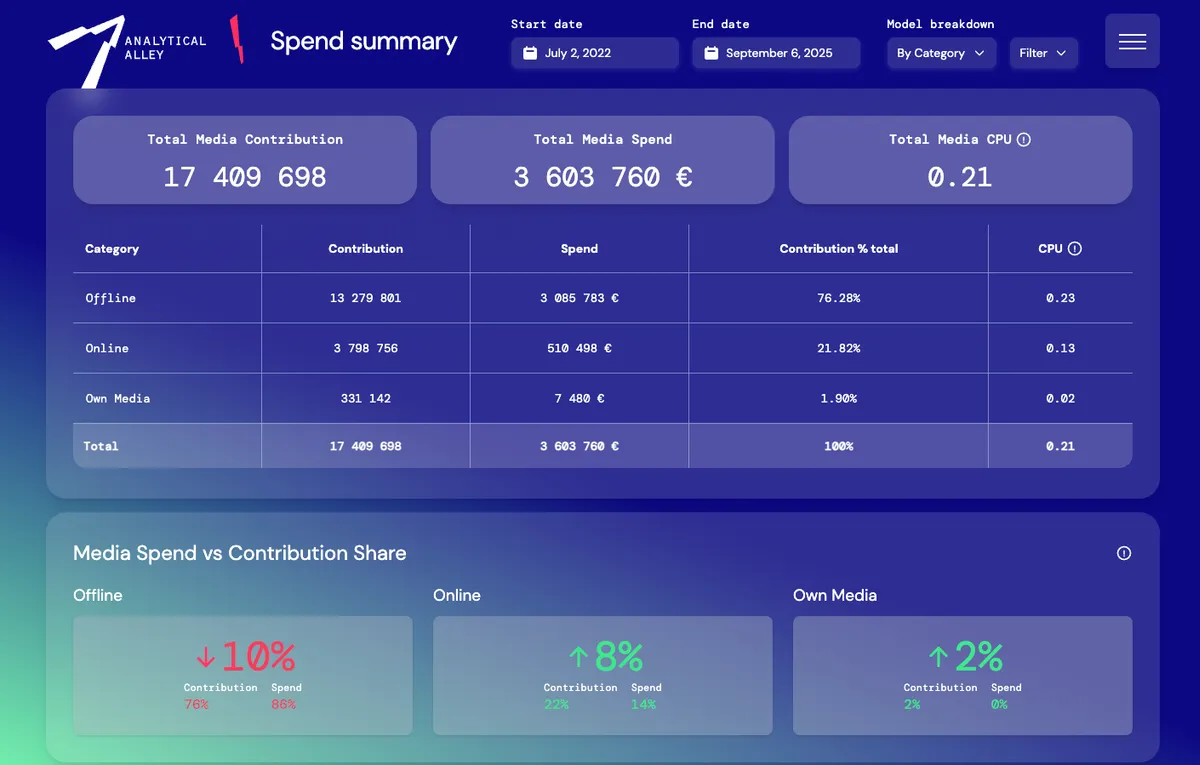
Marketing budget allocation: Optimizing ROI across channels with econometrics

January 6, 2026

Marketing budget allocation is one of the most challenging decisions B2C leaders face all around the world, including our clients in Scandinavia and the Baltic states. With limited resources and growing channels, how do you determine the optimal distribution of your marketing investments? This guide will help you build a data-driven budget allocation strategy using econometric methods to maximize ROI across channels, campaigns, and time periods.

Why traditional marketing budget allocation fails

Most organizations allocate marketing budgets using historical patterns, gut feeling, or channel-specific attribution metrics. These approaches have significant limitations:

  • Platform-reported conversion data often misses 30-60% of actual marketing impact in privacy-conscious Nordic markets
  • Last-click attribution systematically undervalues awareness channels while overvaluing performance channels
  • Marketing channels interact in complex ways that simple attribution fails to capture
  • External factors like seasonality and competition significantly influence results

A study found that only 23% of European marketers holistically measure their digital and traditional media spending - a missed opportunity for optimization.

The econometric foundation for budget allocation

Marketing mix modeling (MMM) provides the econometric foundation for strategic budget allocation. This approach:

  • Uses time-series regression to isolate the incremental impact of marketing investments
  • Accounts for external factors like seasonality, competition, and macroeconomic variables
  • Models carryover effects (adstock) and diminishing returns
  • Quantifies cross-channel synergies and interactions
  • Enables scenario planning and optimization

MMM is particularly valuable in Scandinavian and Baltic markets where privacy regulations like GDPR have limited the effectiveness of user-level tracking.

Bayesian vs. Frequentist approaches in budget allocation

Both Bayesian and Frequentist econometric methods offer value for marketing budget allocation:

Frequentist MMM

  • Provides point estimates of marketing effectiveness
  • Relies on historical data and statistical tests
  • Works well with large, stable datasets
  • Produces outputs like "TV generates an ROI of 2.4" or "Each additional €10,000 in paid social on average generates €24,000 in incremental revenue"

Bayesian MMM

  • Incorporates prior knowledge and business constraints
  • Expresses results as probability distributions, not just point estimates
  • Handles uncertainty more explicitly
  • Produces outputs like "We're 90% confident that YouTube delivers an ROI between 3.1 and 3.9"

Building your data foundation

Effective budget allocation requires a solid data foundation. You'll need:

Required data elements

  • Marketing spend by channel, campaign, and creative (at least 18-24 months of history)
  • Business outcomes (sales, revenue, conversions) aligned to the same time periods
  • Pricing and promotion information
  • External factors (seasonality, competitors, macroeconomic indicators)
  • Brand health metrics (awareness, consideration, preference)

Data granularity considerations

  • Weekly data is typically the sweet spot for MMM
  • Daily data can be noisy but useful for digital optimization
  • Monthly data may miss important within-month patterns

Nordic/Baltic market considerations

  • Ensure coverage across all regional markets where you operate
  • Account for country-specific holidays and seasonal patterns
  • Track local currency fluctuations if operating across markets

The practical budget allocation framework

Follow this framework to implement a data-driven budget allocation strategy:

1. Establish baseline performance

Before optimization, understand your current effectiveness:

  • Separate base sales (what would happen without marketing) from incremental sales
  • Calculate average and marginal ROI for each channel
  • Identify diminishing returns thresholds
  • Map channel synergies and interactions

Baseline sales typically account for 40-70% of total sales in established B2C categories. Understanding this baseline is crucial for accurate measurement.

2. Identify optimization opportunities

Look for four types of budget allocation inefficiencies:

  • Saturation waste: Channels where additional spending yields diminishing returns
    • Example: Paid search ROI dropping from €3.50 to €1.80 per euro spent above €100,000/month
  • Underinvestment: High-ROI channels with room for growth
    • Example: YouTube generating €4.20 per euro spent but receiving only 5% of budget
  • Timing inefficiency: Suboptimal flighting across time periods
    • Example: Heavy summer spending when winter conversion rates are 30% higher
  • Creative fatigue: Declining performance due to audience saturation with messaging

3. Build reallocation scenarios

Use your econometric model to simulate alternative budget allocations:

  • Equalize marginal ROI across channels (the ideal theoretical allocation)
  • Test practical reallocation scenarios (e.g., shifting 20% from saturated paid search to video)
  • Model both short-term sales impact and long-term brand effects
  • Incorporate business constraints and minimum investment thresholds

Marketing mix modeling enables you to run multiple scenarios and forecast the impact of each, helping you make data-driven allocation decisions.

4. Implement with controlled testing

When implementing new allocations:

  • Use geographic or audience holdouts to measure true incrementality
  • Test for 8-12 weeks to capture full effects
  • Monitor leading indicators (traffic, engagement) and lagging metrics (sales, ROI)
  • Adjust based on results before full-scale implementation

Channel-specific insights for Nordic and Baltic markets

Econometric analysis reveals important patterns in these markets:

Digital channels

  • Paid search: Typically delivers 200-400% ROI, with brand terms at 400-600% and generic terms at 150-300%
  • Paid social: Generally achieves 150-350% ROI, with prospecting at 100-200% and retargeting at 300-500%
  • Display: Usually delivers 50-150% ROI, with programmatic at 50-100% and premium placements at 150-250%
  • Video: Often generates 100-250% ROI with proper attribution windows (14-28 days)

Traditional channels

  • TV: Still effective in Nordic markets despite fragmentation, with strong brand-building effects
  • Radio: Cost-efficient reach in Baltic markets with 100-250% ROI in many categories
  • OOH: Particularly effective in urban centers like Stockholm, Helsinki and Tallinn
  • Print: Declining but still relevant for certain demographics, especially older audiences

Regional specifics

  • L'Oréal's Nordic MMM studies found that 6-second bumper ads had higher ROI than longer-form video formats, though results were supplemented by other formats for sustained effectiveness
  • SATS deployed Marketing Mix Modeling in the Nordics and identified TikTok's high ROI with top-performing formats
  • Baltic marketing strategies emphasize localization, with effectiveness enhanced by understanding local consumer behavior and preferences

Optimizing budget allocation across time

Timing is as important as channel selection in Nordic and Baltic markets:

Seasonal factors

  • Account for extreme seasonal variations in consumer behavior, particularly in Nordic countries
  • Adjust for extended summer holiday periods when reach and engagement patterns change dramatically
  • Plan for significant seasonal shopping events (Christmas, post-Christmas sales, etc.)

Day-of-week and time-of-day patterns

  • Digital engagement patterns differ between Nordic and Baltic markets
  • Use econometric methods to identify optimal flighting patterns by day and time
  • Adjust budgets to capitalize on high-efficiency periods

Long vs. short-term allocation

  • Allocate approximately 50-60% of budget to brand-building (long-term) activities
  • Reserve 40-50% for activation and performance (short-term) activities
  • Use econometrics to balance short and long-term effectiveness

Common pitfalls in budget allocation

Avoid these common mistakes:

Over-relying on last-click attribution

Last-click systematically biases toward lower-funnel channels. Econometric analysis often reveals that awareness channels like TV, podcasts, and YouTube create a halo effect that improves lower-funnel performance by 15-40%.

Ignoring lag effects and carryover

Many channels in Nordic markets show significant carryover effects. A channel might show an immediate ROI of 1.5 but a total ROI of 3.2 after accounting for carryover. Diminishing returns analysis helps identify when additional investment delivers diminishing value.

Failing to account for external variables

Seasonal or competitor-driven effects can mislead performance interpretation unless models control for external factors. A retailer might misattribute a 30% November paid search lift to channel efficiency rather than seasonality.

Optimizing for the wrong objective

Be clear whether you're optimizing for revenue, profit, market share, or customer lifetime value - different objectives require different mixes.

Advanced optimization techniques

Take your allocation strategy to the next level:

Dynamic budget allocation

  • Implement automated systems that adjust budgets based on real-time performance
  • Set rules-based triggers for budget shifts (e.g., when CPAs fall below thresholds)
  • Use machine learning to predict optimal allocations as conditions change

Cross-brand allocation

  • For multi-brand portfolios, optimize not just within brands but across the portfolio
  • Account for brand interactions and potential cannibalization
  • Allocate resources to brands with the highest marginal ROI

Creative optimization within channels

  • Creative quality can drive 3-5x differences in ROI within the same channel
  • Decompose creative by attributes (tone, product focus, celebrity) to model incremental sales vs. brand equity
  • Allocate budget to winning creative approaches

Implementing your allocation strategy

Turn insights into action with these implementation steps:

Organizational alignment

  • Create a cross-functional team including marketing, finance, and analytics
  • Establish a regular cadence for reviewing performance and making allocation decisions
  • Ensure executive sponsorship and buy-in for the econometric approach

Continuous learning

  • Implement a test-and-learn agenda to validate model recommendations
  • Conduct post-campaign analysis to refine future allocations
  • Update models regularly as new data becomes available

Performance monitoring

  • Track key metrics against forecasts and adjust when performance deviates
  • Set thresholds for when to trigger reallocation (e.g., when performance deviates >10% for two weeks)
  • Celebrate and communicate wins to build organizational confidence in the approach

Your next steps

Ready to implement data-driven budget allocation? Start with these four critical actions:

  1. Assess your data readiness - Do you have 18-36 months of consistent marketing and sales data?
  2. Determine build vs. buy - Will you build in-house capabilities or partner with specialists?
  3. Start with a focused test - Apply econometric allocation to a subset of your budget
  4. Measure and expand - Track results and expand the approach as you validate the impact

Analytical Alley's mAI-driven media strategy combines AI computing power and human insight to help B2C brands in the Nordic and Baltic regions optimize their marketing budget allocation. With a comprehensive multivariable model that predicts the impact of all factors with over 90% accuracy, you can make confident allocation decisions that maximize ROI.

Budget allocation isn't a one-time exercise but an ongoing process of optimization. By applying econometric methods to your marketing investments, you'll gain a competitive advantage through more efficient and effective marketing spend.