How to estimate adstock decay rates for B2C marketing
Analytical Alley Team
Marketing Analytics Experts
Why does your B2C advertising continue to drive sales weeks after a campaign ends? If your attribution models ignore this lag, you are likely misallocating your marketing budget.
What is adstock d...
Why does your B2C advertising continue to drive sales weeks after a campaign ends? If your attribution models ignore this lag, you are likely misallocating your marketing budget.
What is adstock decay and why does it matter?
In B2C marketing, consumer purchasing cycles rarely align perfectly with the timing of your ad spend. A buyer might watch a television spot today but delay their actual purchase for several weeks. This delayed response is known as the carryover effect.
To capture this mathematically within your marketing mix modeling efforts, you must use adstock. This econometric transformation quantifies how advertising awareness builds up and gradually fades.
The most common specification is the geometric decay formula:
$$Adstock(t) = Media(t) + lambda times Adstock(t-1)$$
In this equation, $Adstock(t)$ represents the adstock value at time $t$, while $Media(t)$ denotes the marketing spend or exposure (such as impressions) in that same period. The parameter $lambda$ (lambda) represents the decay rate, constrained between 0 and 1.
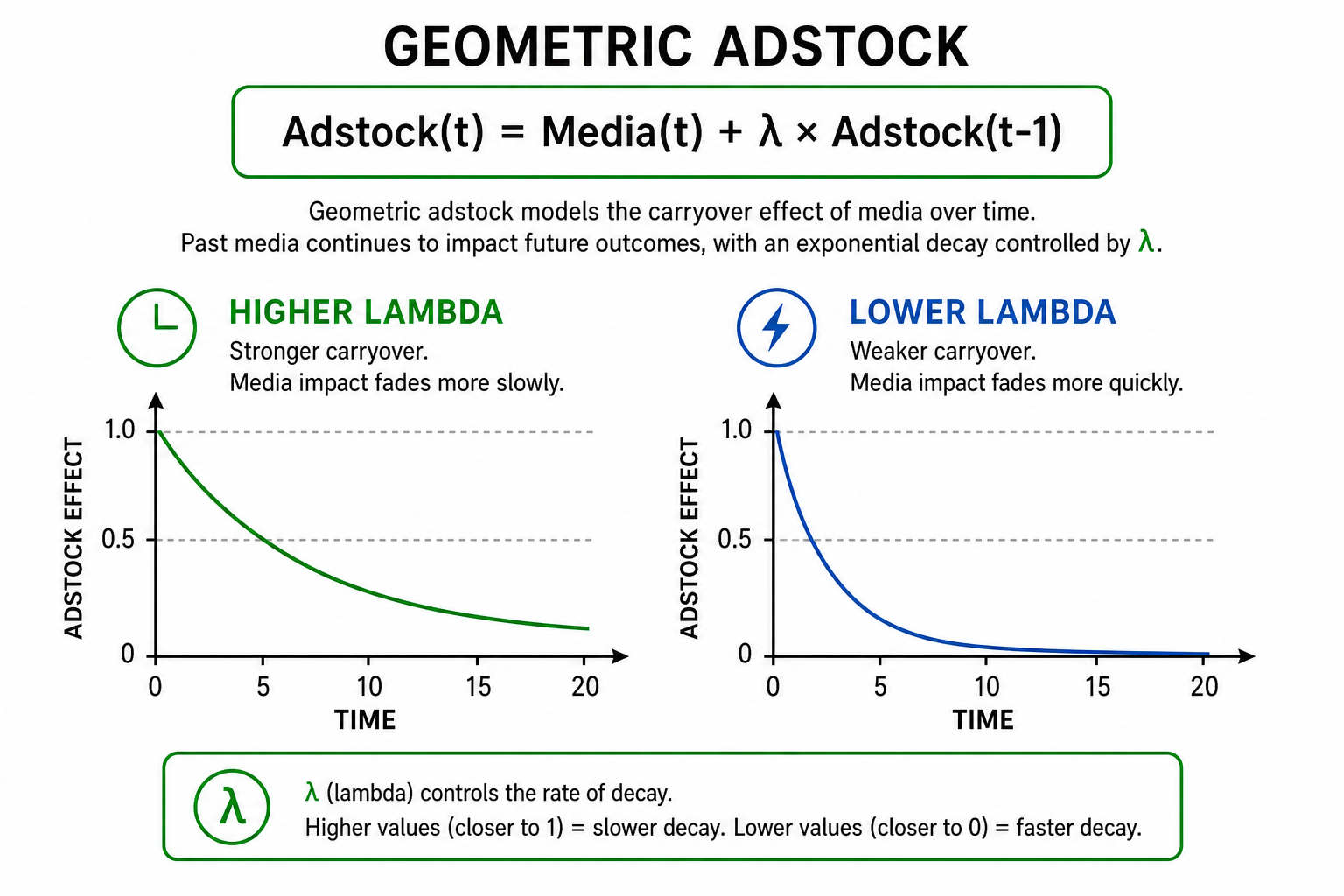
A decay rate closer to 1 (such as 0.8) means the advertising effect fades slowly, persisting for weeks. A decay rate closer to 0 (such as 0.1) indicates rapid decay, where the impact is highly immediate and short-term. For example, offline brand-building channels like TV often exhibit high adstock rates (0.4 to 0.8), while highly tactical digital channels like paid search decay quickly (0.1 to 0.4). Properly calculating adstock rates ensures your models reflect this reality rather than relying on distorted ROI calculations.
Why accurate decay estimation is crucial for B2C brands
Failing to estimate adstock decay rates correctly leads to a series of analytical errors that distort your strategic planning:
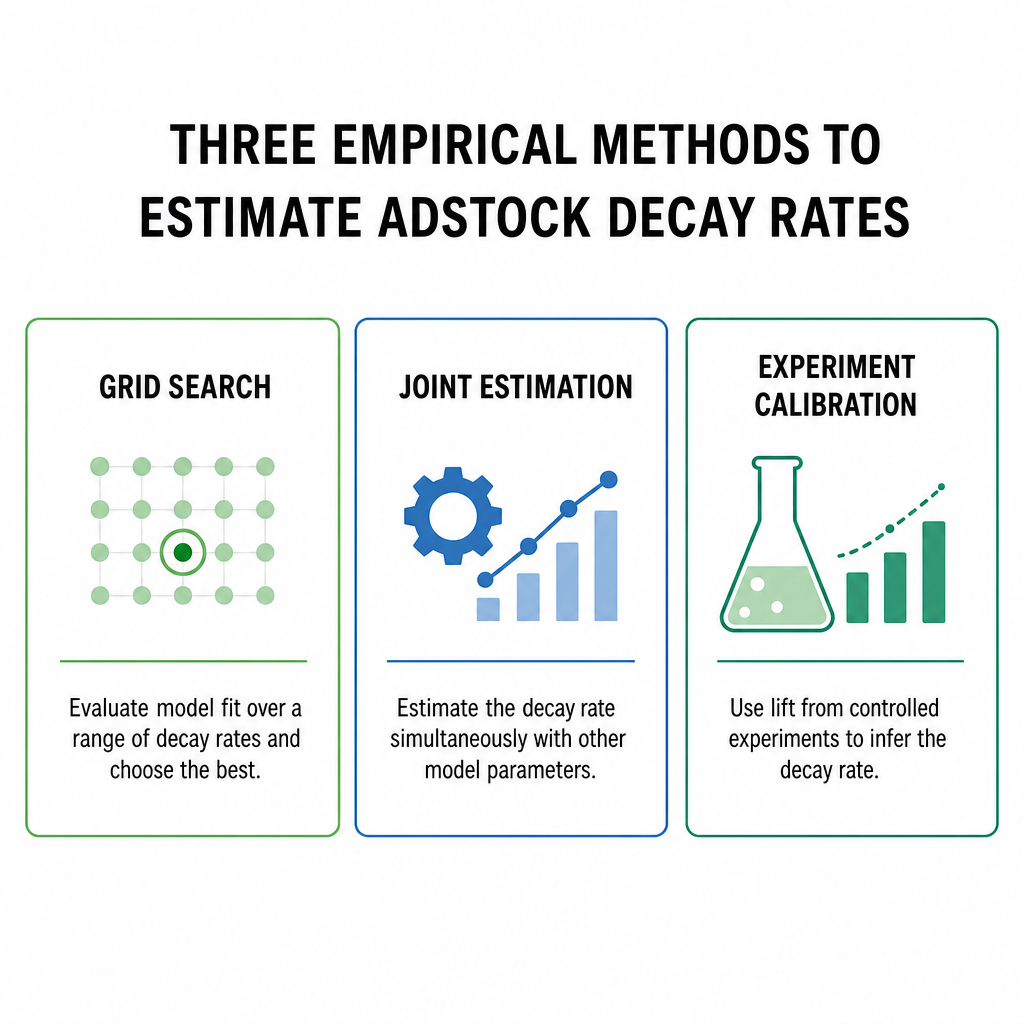
Three methods to estimate adstock decay rates
To build a reliable modeling framework, you cannot rely on generic industry benchmarks. You must estimate decay rates empirically using your historical data.
Optimization and grid search
This approach involves running multiple model iterations with different decay rates (for example, testing $lambda$ values from 0.05 to 0.95 in increments of 0.05). The model that minimizes prediction error and yields the most plausible coefficients is selected. This is highly effective when paired with automated marketing mix modeling data science workflows.
Joint parameter estimation
Instead of pre-calculating adstock before feeding it into your regression model, advanced models estimate decay rates and saturation parameters simultaneously. This joint estimation prevents multi-stage bias and ensures that the interactions between carryover and nonlinear shape effects are preserved.
While there is significant discussion in the industry regarding the use of Frequentist or Bayesian frameworks to achieve this, the practical reality is that both approaches have their merits. Rather than focusing on statistical philosophy, your priority should remain on model stability, transparency, and robust validation.
Calibration with real-world experiments
No econometric model should live in a vacuum. You should validate and calibrate your estimated decay rates using empirical experiments, such as:
Core data requirements for modeling adstock
Before you begin calculating your variables, ensure your data infrastructure is prepared. Robust estimation requires:
Review our MMM data requirements checklist to audit your preparation before starting the model build.
Designing a resilient measurement strategy
To make your modeling efforts decision-ready, treat your marketing mix model as an always-on capability. Consumer habits and media channels evolve, meaning decay rates calculated two years ago may no longer apply to your current campaigns.
For C-suite executives, having a validated model means you can run predictive forecasting scenarios with confidence. For media buyers and strategists, it provides the precise marginal ROI metrics needed to shift budgets dynamically without risking sales volume.
Whether you are looking to build in-house capabilities or need a trusted partner, our solutions for data scientists and specialized tools for marketers help European brands eliminate waste and make calculated growth decisions. Explore our knowledge hub to learn more, or see our methodology in action by reviewing our solutions for executives.
Get Marketing Analytics Insights
Monthly briefings on marketing mix modeling, budget optimisation and what's actually moving the needle for European brands.