How to audit marketing models to cut ad waste by 40%
Analytical Alley Team
Marketing Analytics Experts

Can you confidently justify your B2C media allocation to your board when hundreds of thousands if not millions are on the line? Unpacking black-box analytics is no longer optional; it is a core govern...
Can you confidently justify your B2C media allocation to your board when hundreds of thousands if not millions are on the line? Unpacking black-box analytics is no longer optional; it is a core governance requirement to protect your margins.
For marketing strategists and C-suite executives across Scandinavia, the Baltics, and broader Europe, choosing an analytics vendor is a high-stakes decision. As privacy regulations tighten and third-party tracking disappears, marketing mix modeling has become the gold standard for privacy-compliant performance measurement.
However, many vendors hide their statistical methods behind a curtain of proprietary algorithms. If your leadership team cannot verify the underlying mathematics, you are flying blind. Transparent models are essential to ensure recommendations align with business reality. When a vendor cannot or will not provide clear transparency, the solution is not fully auditable or decision-ready.
Why explainability matters for the C-suite
This focus on transparency is reflected in international frameworks. The National Institute of Standards and Technology (NIST) Artificial Intelligence Risk Management Framework identifies transparency and explainability as core characteristics of trustworthy AI. Under these guidelines, organisations must document how systems work, disclose appropriate information to stakeholders, and make model behaviour interpretable. While current U.S. AI regulation remains fragmented across different sectors and states, non-binding frameworks like the NIST AI RMF set a benchmark for European organisations establishing internal governance.
We believe there is too much hype around Frequentist versus Bayesian modeling. Rather than getting lost in academic debates, you should focus on whether a vendor provides practical, auditable, and transparent outcomes that protect your bottom line.
Core explainability standards to demand from vendors
When reviewing an analytics vendor's platform or request for proposal, look for three foundational transparency requirements.
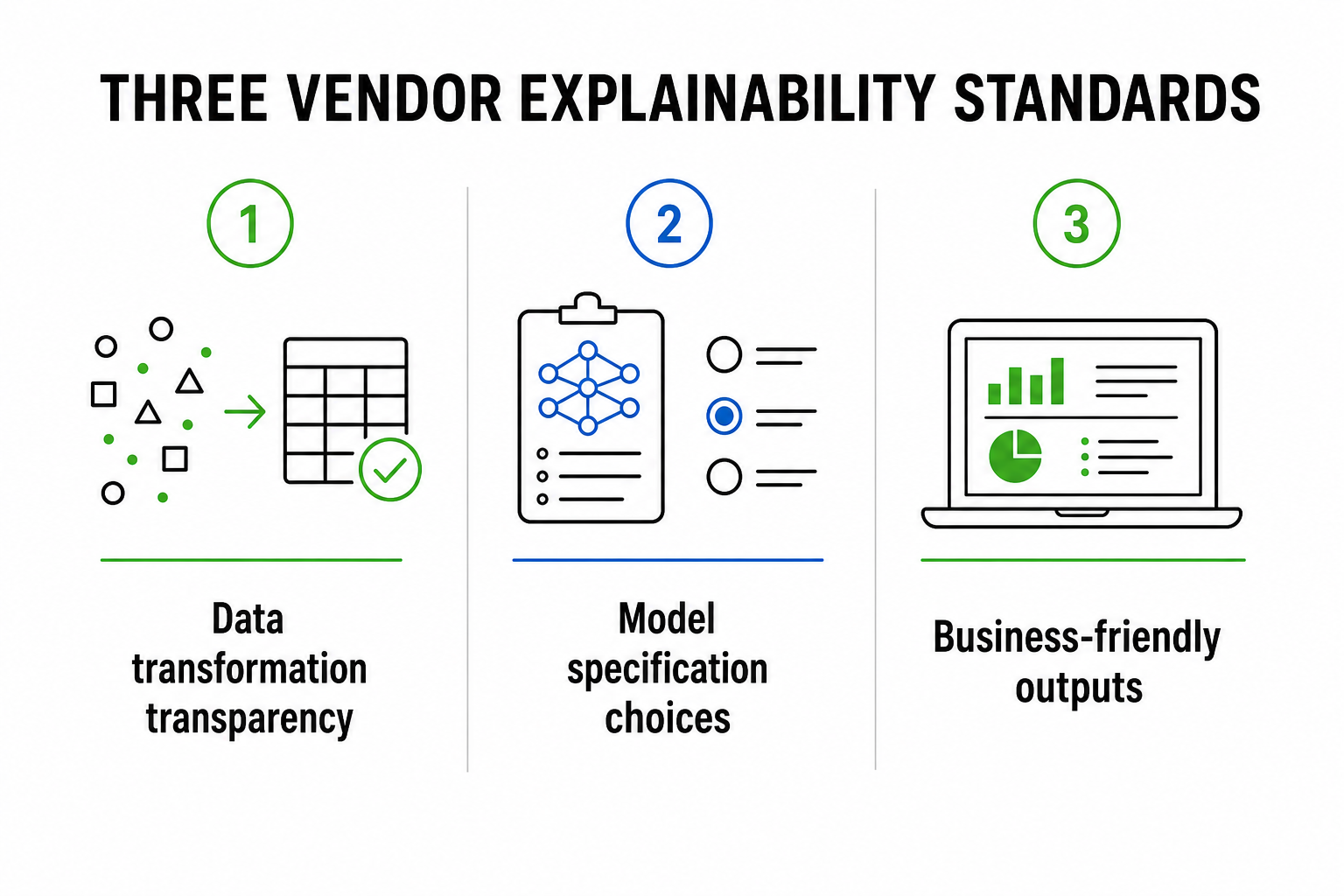
Data transformation transparency
Your model is only as good as the data feeding it. Vendors must provide clear documentation of data sources, data transformations, and any imputations or interpolations applied to fill in gaps. You should easily trace how raw data from your marketing data warehouse schema is prepared for analysis. Before starting, ensure your team reviews the foundational data requirements for econometrics and utilises a comprehensive MMM data requirements checklist to audit your internal data readiness.
Model specification choices
A transparent vendor must document and explain their model specification choices. This documentation should detail:
These elements are vital for accurate econometric forecasting, as they dictate how the model estimates carryover effects and marginal returns.
Business-friendly outputs
An executive dashboard should not require a PhD in statistics to interpret. Require vendors to provide plain, business-friendly explanations of model outputs. You need to understand exactly how the model calculates ROI, channel contributions, and marginal returns so you can present these figures to your board with confidence.
Technical governance and validation requirements
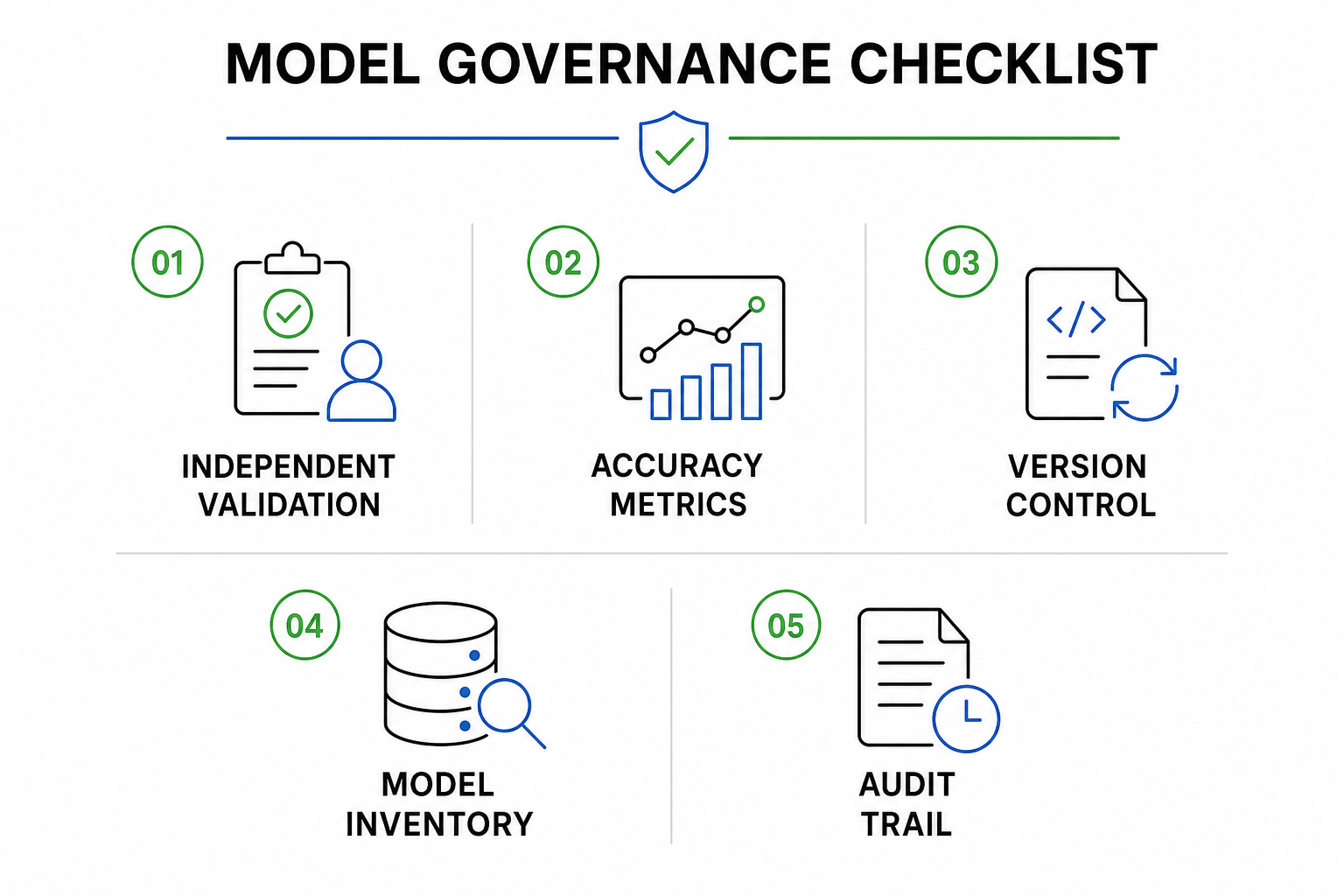
Reliable model governance is heavily influenced by established risk management frameworks, such as the SR 11-7 supervisory guidance on model risk management. This guidance sets expectations for independent validation, governance structures, model inventory, and detailed documentation.
Robust validation processes
A reliable vendor must validate model performance using both in-sample fit and out-of-sample or holdout tests. They should openly report key accuracy metrics, such as Mean Absolute Percentage Error (MAPE) and R-squared values. In-depth marketing mix modeling data science principles require that holdout tests prove the model's predictive power on unseen historical data. The multiple linear regression model can be expressed as:
$$Sales = Base + beta_1(Channel_1) + Seasonality + External_factors + Error$$
Controls to prevent overfitting
Overfitting occurs when a model is so highly tuned to past data that it fails to predict future outcomes accurately. Ensure your vendor uses regularization, maintains parsimony in variable selection, and avoids frequent, unjustified model re-tuning.
Independent auditability and model inventory
To maintain a clear audit trail, your analytics platform must feature version control for all model code, data inputs, and outputs. Marketers or their independent experts must have the ability to validate, reproduce, and audit the results using the same underlying data and code.
In line with SR 11-7 expectations, a vendor should maintain a comprehensive model inventory that documents:
Driving growth with transparent analytics
Evaluating a vendor against these criteria ensures that your marketing strategies are built on a secure foundation. At Analytical Alley, our mAI-driven media strategy combines advanced computing power with human expertise to deliver validated econometric models with over 90% accuracy.
By choosing a framework that prioritises robust governance and open methodologies, you can confidently optimize your media spend, eliminate guesswork, and slash ad waste by up to 40%.
Discover how we deliver financial-grade reporting and clear, auditable insights by exploring our solutions for executives or our dedicated platform for performance marketers.
Get Marketing Analytics Insights
Monthly briefings on marketing mix modeling, budget optimisation and what's actually moving the needle for European brands.