Cut B2C ad waste by 40% using incrementality tests
Analytical Alley Team
Marketing Analytics Experts
Are you wasting budget on customers who would have purchased anyway? Many European B2C brands struggle with attribution models that take credit for organic sales, but experimental design reveals the t...
Are you wasting budget on customers who would have purchased anyway? Many European B2C brands struggle with attribution models that take credit for organic sales, but experimental design reveals the true causal lift of your marketing.
What is incrementality and why does it matter?
In B2C marketing, incrementality represents the true, additional impact generated by a specific campaign. It measures the extra conversions, revenue, or customer actions directly caused by your advertising that would not have occurred without it.
Many digital advertising platforms suffer from self-attribution bias, taking credit for conversions that organic channels would have captured anyway. This is highly prevalent in remarketing or branded search campaigns, where high returns often mask a lack of true incremental value. To stop over-allocating budget to non-incremental tactics, you can identify these biases by measuring retargeting incrementality through structured experiments. Focusing on causal lift rather than last-click metrics allows you to identify exactly where your media spend drives real business growth.
The core of experimental design: test vs. control
Well-designed experiments are the strongest tools available for measuring causality. To design a clean incrementality test, you must split your target audience into two distinct groups.
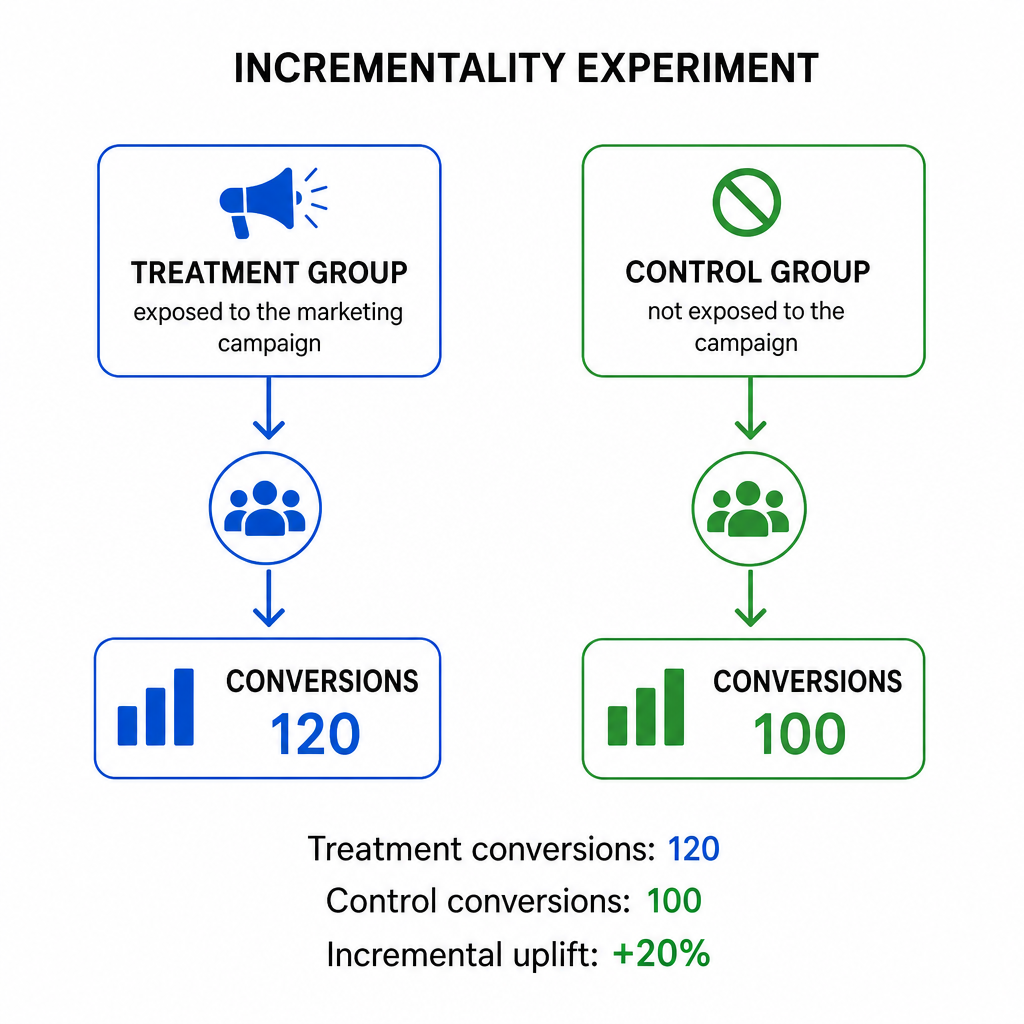
By comparing the performance metrics between these two groups, you isolate the campaign's true causal lift from outside variables like seasonality, pricing shifts, or economic trends.
To calculate the percentage lift of your campaign, apply this formula:
$$ text{Percentage Lift} = frac{text{Treatment Outcomes} - text{Control Outcomes}}{text{Control Outcomes}} times 100$$
This calculation gives you a clear, statistically sound baseline of your advertising effectiveness.
Practical incrementality testing methods for European brands
Depending on your B2C channel mix, privacy constraints, and target markets in Scandinavia, the Baltics, or broader Europe, you can deploy several experimental methods.
User-level holdouts
Platforms like Meta and Google offer native conversion lift studies. They automatically segment your audience, holding out a control group to measure the difference in conversion rates. This is highly effective for walled-garden digital channels, though browser privacy changes have made user tracking more challenging.
Geo-lift testing
When user-level tracking is unavailable or unreliable, geo experiments are the gold standard. In a geo-lift test, you hold out specific geographic regions (such as certain cities or regions across Sweden or Denmark) from your marketing campaigns. You then compare their sales performance against highly similar regions where your ads remain active. Discover how to apply this to your strategy by exploring our overview on measuring incrementality.
Ghost ads and public service announcements
If you cannot easily hold out an audience, you can show control users a public service announcement (PSA) or place a ghost ad. This flags when a control user would have won the ad auction without actually showing them the ad, allowing you to compare conversion rates among users who had the exact same opportunity to see your creative.
Connecting experiments to your marketing mix model
While isolated experiments provide highly accurate, empirical proof of causal lift for specific tactics, they are difficult to run continuously across every channel. This is where Marketing Mix Modeling (MMM) becomes essential.
Modern, advanced MMM approaches use experimental results to calibrate their statistical algorithms. By importing your incrementality test results as priors or constraints within your multi-variable model, you ensure that your high-level channel contribution models align with real-world causal evidence. While some modelers debate the academic merits of Bayesian versus Frequentist frameworks, modern practitioners focus on practical calibration rather than statistical hype.
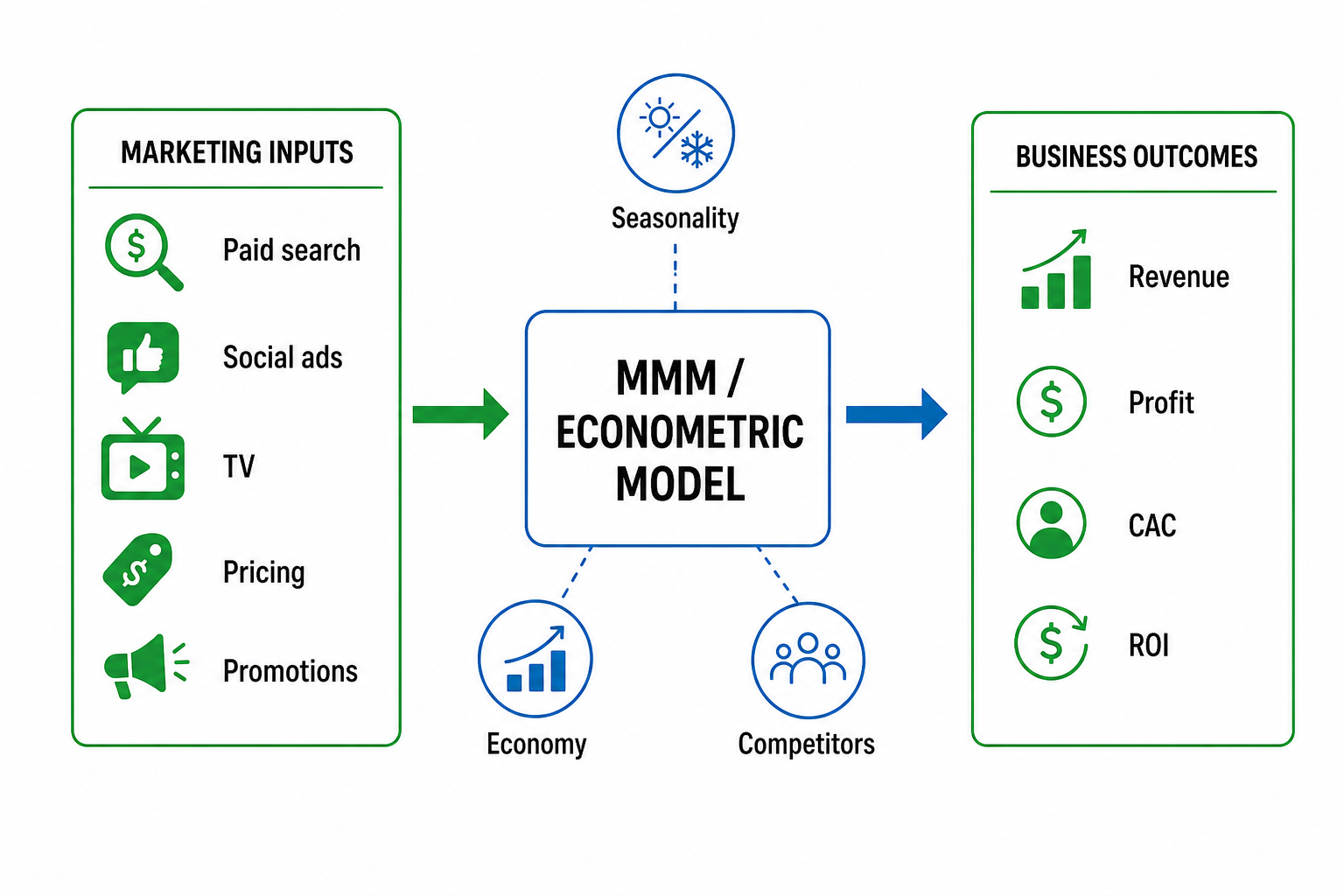
Integrating these methods allows you to scale the scientific rigor of individual lift tests across your entire yearly budget. You can learn more about this unified approach in our guide to MMM plus lift testing, and compare different validation methods in our breakdown of brand lift studies vs MMM.
Transform marketing from a cost center to a growth engine
To align the C-suite and secure budget flexibility, CMOs must deliver the clear financial proof that CEOs and CFOs expect. Aligning the C-suite around customer-centric growth is the single most important step for companies aiming to harness the full power of marketing. Combining experimental design with econometrics provides the transparent, auditable methodology needed to build institutional trust, proving that your campaigns act as a genuine growth engine.
Analytical Alley's mAI-driven media strategy combines advanced AI computing power with deep human insight to help European organisations build high-accuracy models. Our multi-variable approach predicts marketing impact with over 90% accuracy, helping brands slash ad waste by up to 40% through smart, calculated decisions.
Ready to find out where your money works best and prove the true ROI of your marketing spend? Explore our solutions for marketers to optimise tactical campaigns, or learn how we support executives with strategic forecasting and risk management. You can also visit our Analytical Alley knowledge hub to read our latest reports and take control of your media strategy.
Get Marketing Analytics Insights
Monthly briefings on marketing mix modeling, budget optimisation and what's actually moving the needle for European brands.