How hierarchical marketing mix modeling improves B2C accuracy
Analytical Alley Team
Marketing Analytics Experts

Are you struggling to measure marketing ROI across different European regions or product lines? Standard models often fail when data is sparse, but hierarchical structures allow you to borrow insights...
Are you struggling to measure marketing ROI across different European regions or product lines? Standard models often fail when data is sparse, but hierarchical structures allow you to borrow insights across categories to stabilize results and reduce ad waste.
Understanding hierarchical structures in econometrics
Hierarchical marketing mix modeling (MMM) is a layered statistical approach designed for B2C brands operating across multiple dimensions. Instead of treating every region or product as a completely isolated silo, a hierarchical model recognizes that they belong to a larger group.
In marketing mix modeling, this means you can analyze sales drivers like media spend across various units, such as geographies or brands, simultaneously. This structure is particularly effective for European organizations managing portfolios across the Nordics or Baltics, where market sizes and data availability vary significantly between countries.
The role of Bayesian partial pooling
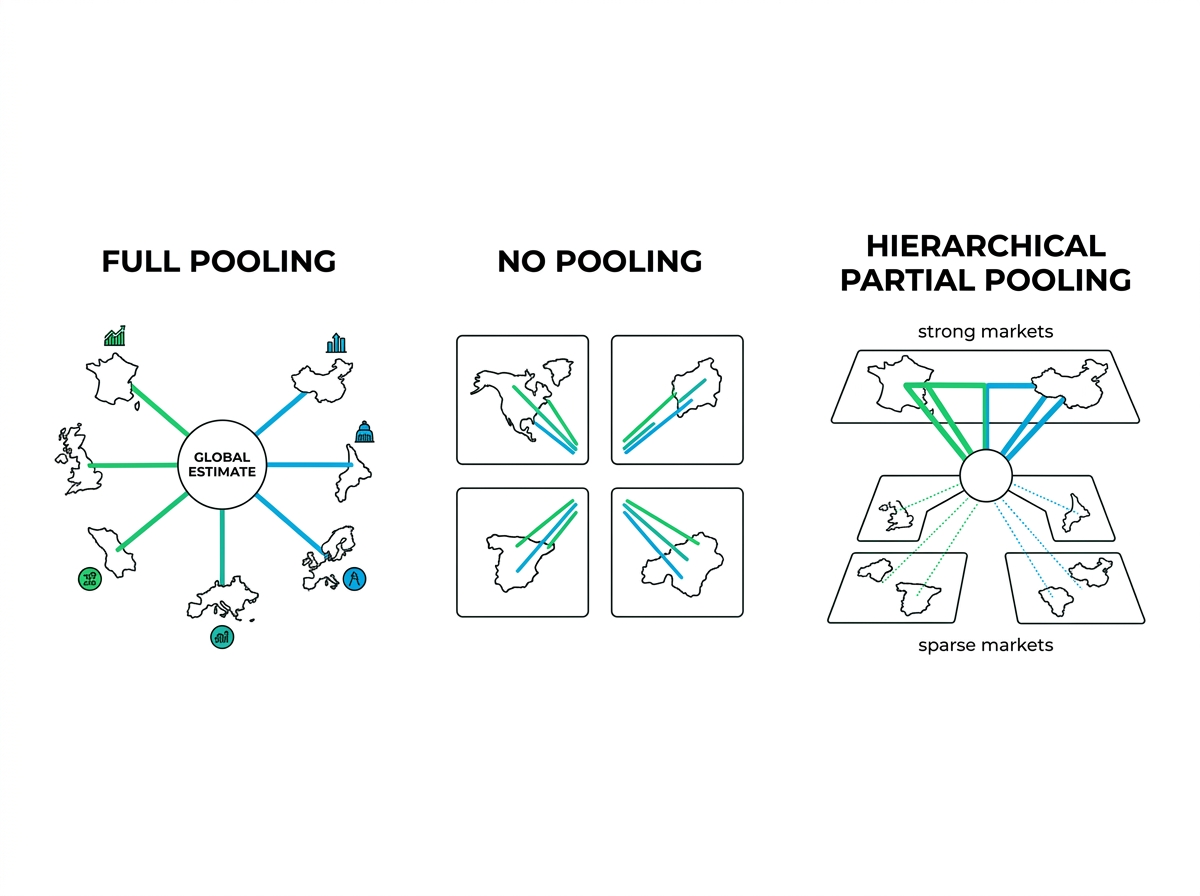
The core strength of hierarchical models lies in partial pooling. In traditional econometrics, you often face a choice between full pooling, where you assume every market behaves exactly the same, and no pooling, which involves running separate models for every market. The former ignores local nuances, while the latter leads to unstable results if a specific region has limited data.
Hierarchical models find the middle ground by using shared hyperpriors to borrow strength across units. If you have a high-spending market with clear data, the model uses those insights to inform the estimates for smaller, sparser markets. This balances local data with group wisdom, ensuring that even low-volume regions receive a stable ROI estimate without assuming every market is identical.
Core components of the model
To maintain over 90% accuracy, these models incorporate fundamental econometric forecasting elements that capture the reality of consumer behavior. Adstock represents the carryover effect of advertising, recognizing that a campaign seen today influences behavior for weeks to come. This is mathematically expressed as $Adstock_t = Spend_t + theta times Adstock_{t-1}$.
Alongside this, saturation curves model diminishing returns where spending more yields less extra sales per dollar over time. This is typically calculated using a Hill function: $Effect = frac{Spend^alpha}{K^alpha + Spend^alpha}$. Models also account for baseline demand, which represents the volume of sales you would achieve with zero marketing spend. This baseline is often driven by brand equity and specific seasonal patterns such as seasonality in the Nordics. Finally, random effects allow the model to account for local deviations, ensuring a region with a higher response to TV ads than the national average is accurately represented.
Why hierarchical models outperform separate models
For C-suite executives and media buyers, the primary benefit of this approach is increased stability. Research indicates that hierarchical structures can improve accuracy by 15% to 30% in sparse data environments. In econometrics for FMCG, where product categories might have uneven spend, hierarchical sharing can reduce ROAS variance by 20%.
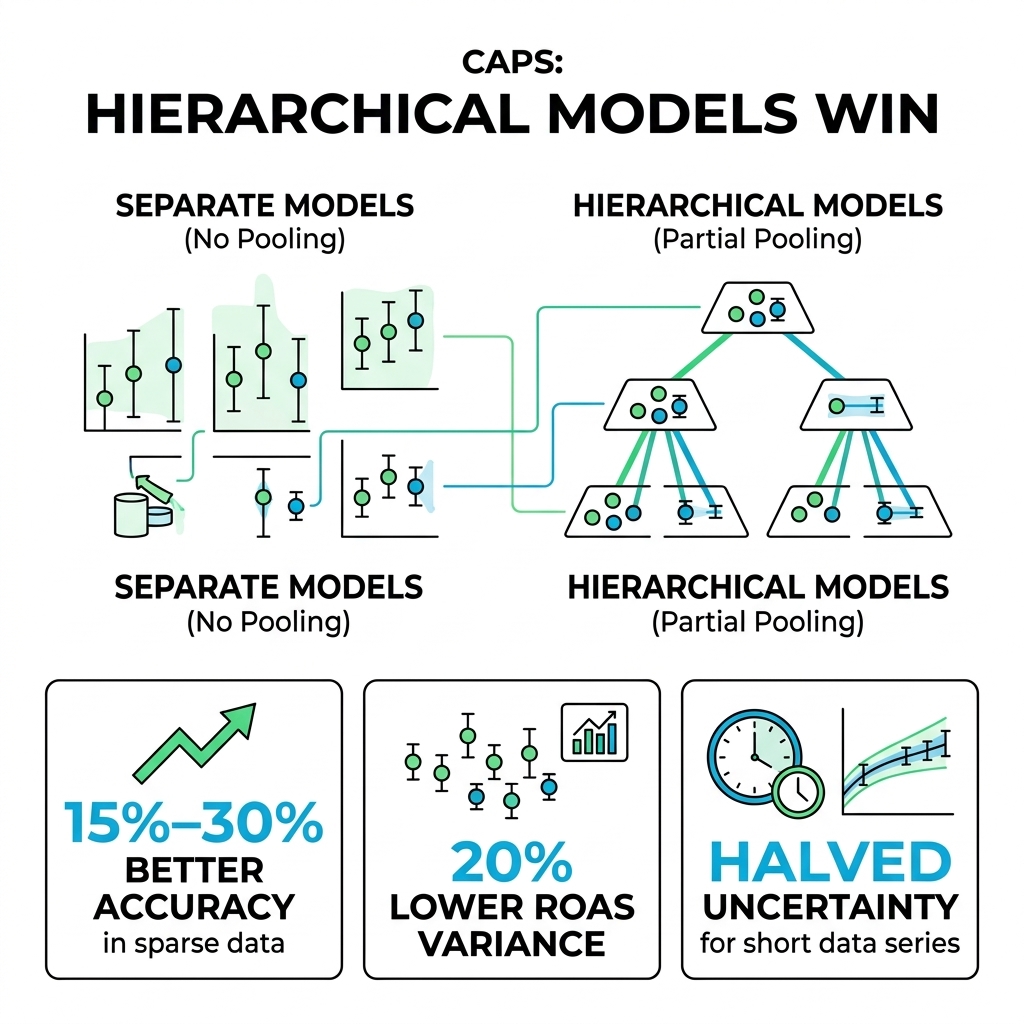
If you are working with short data series of less than two years, these models can halve the uncertainty in your parameters compared to independent models. This prevents the noisy results that often lead to poor budget reallocation decisions, allowing for more confident shifts in media strategy.
Practical B2C use cases
Hierarchical modeling is highly versatile for complex B2C environments across different sectors:
Implementation requirements and limitations
While powerful, these models have specific data requirements for econometrics. You typically need at least one to two years of weekly data per unit to build a reliable foundation. The computational intensity is also significantly higher than standard regressions, as the estimation process can take much longer to process.
Furthermore, you must be careful with prior sensitivity. If the group wisdom is too strong, it may mute genuine local nuances. Regular validation through time-based splits and multicollinearity checks is essential to ensure the model reflects reality rather than statistical noise.
Enhance your measurement accuracy
Hierarchical marketing mix modeling provides the technical bridge between global strategy and local execution. By leveraging these structures, you can gain a clearer picture of your true marketing impact, even in markets where data is difficult to come by.
Analytical Alley combines AI computing power with human insight to help you slash ad waste by up to 40%. Our multivariable models predict the impact of all your marketing activities with over 90% accuracy.
Explore our marketing mix modeling solutions by booking a demo with Analytical Alley.
Get Marketing Analytics Insights
Monthly briefings on marketing mix modeling, budget optimisation and what's actually moving the needle for European brands.