Incrementality vs. last-click: finding your true marketing lift
Analytical Alley Team
Marketing Analytics Experts

Are you paying for customers who would have bought from you anyway? While last-click attribution offers speed, it often fails to distinguish between marketing that creates new demand and marketing tha...
Are you paying for customers who would have bought from you anyway? While last-click attribution offers speed, it often fails to distinguish between marketing that creates new demand and marketing that simply claims credit for existing sales.
The fundamental divide between correlation and causation
The difference between last-click attribution and incrementality is the difference between observing a path and proving a cause. Last-click attribution gives 100% credit to the final touchpoint before a conversion, regardless of what actually sparked the interest. It provides a record of a digital journey, but it fails to account for the causal factors that initiated that journey.
In contrast, incrementality isolates the causal impact of your marketing by controlling for external variables like seasonality, pricing, and baseline demand. By using marketing mix modeling, you can determine which sales were truly driven by an ad and which would have happened naturally. Understanding this econometrics vs attribution divide is essential for any brand looking to move beyond surface-level metrics.
Why the baseline matters for B2C brands
In the B2C sector, base vs incremental sales analysis reveals a critical reality: baseline sales typically account for 40% to 70% of total revenue. These sales are driven by long-term factors like brand equity, physical availability, and historical consumer habits rather than immediate ad exposure.
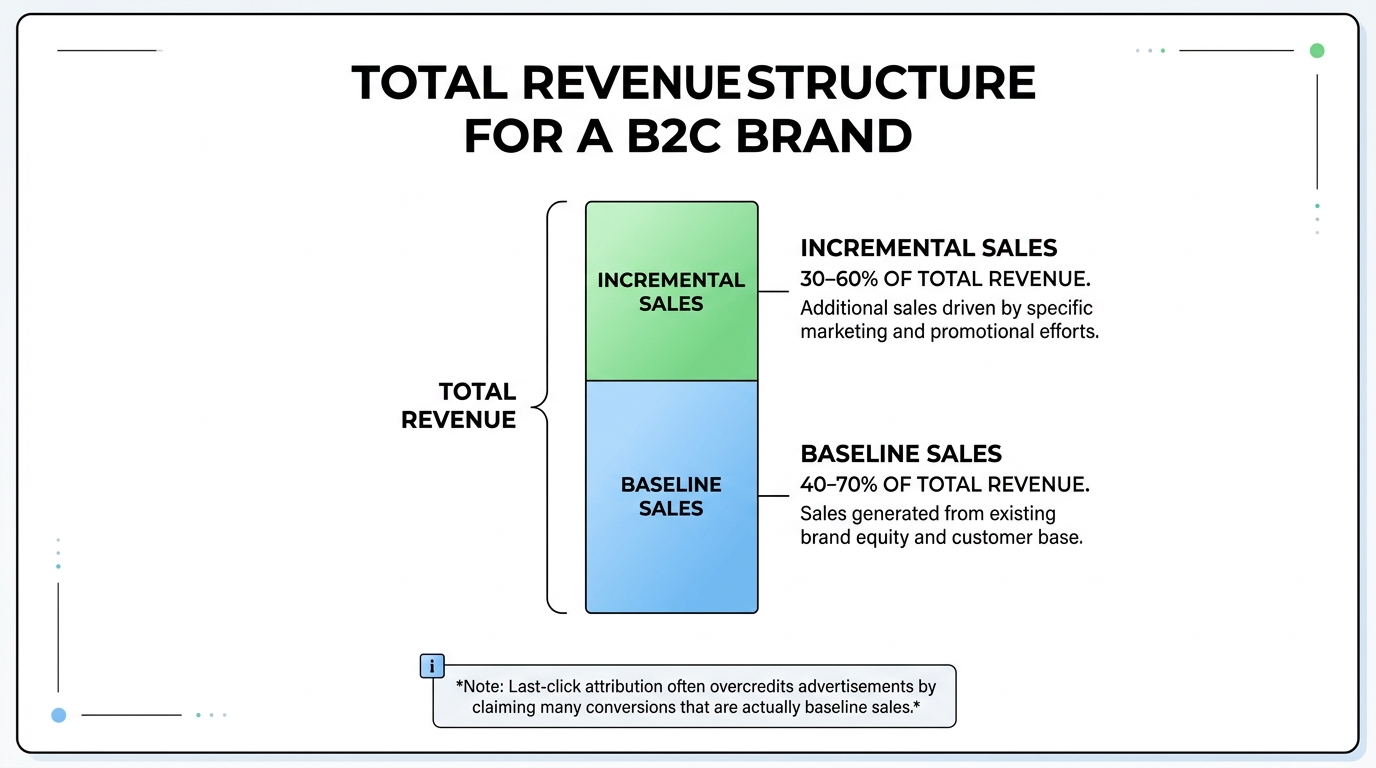
Last-click models ignore this baseline entirely. They treat every tracked conversion as a direct result of the final ad clicked, which creates a significant bias. This is most visible in branded search, where research shows that 60% to 80% of conversions are non-incremental. If a customer searches specifically for your brand name, they are usually already primed to convert. Crediting a search ad for that sale leads to inflated ROI figures and strategic over-investment in channels that are merely capturing existing demand rather than creating new growth.
Critical limitations of last-click attribution
Last-click is a tactical tool, not a strategic one. It excels at daily optimizations for media buyers, such as testing creative versions within a specific campaign, but it fails to support board-level decisions for several reasons:
How econometrics isolates true incrementality
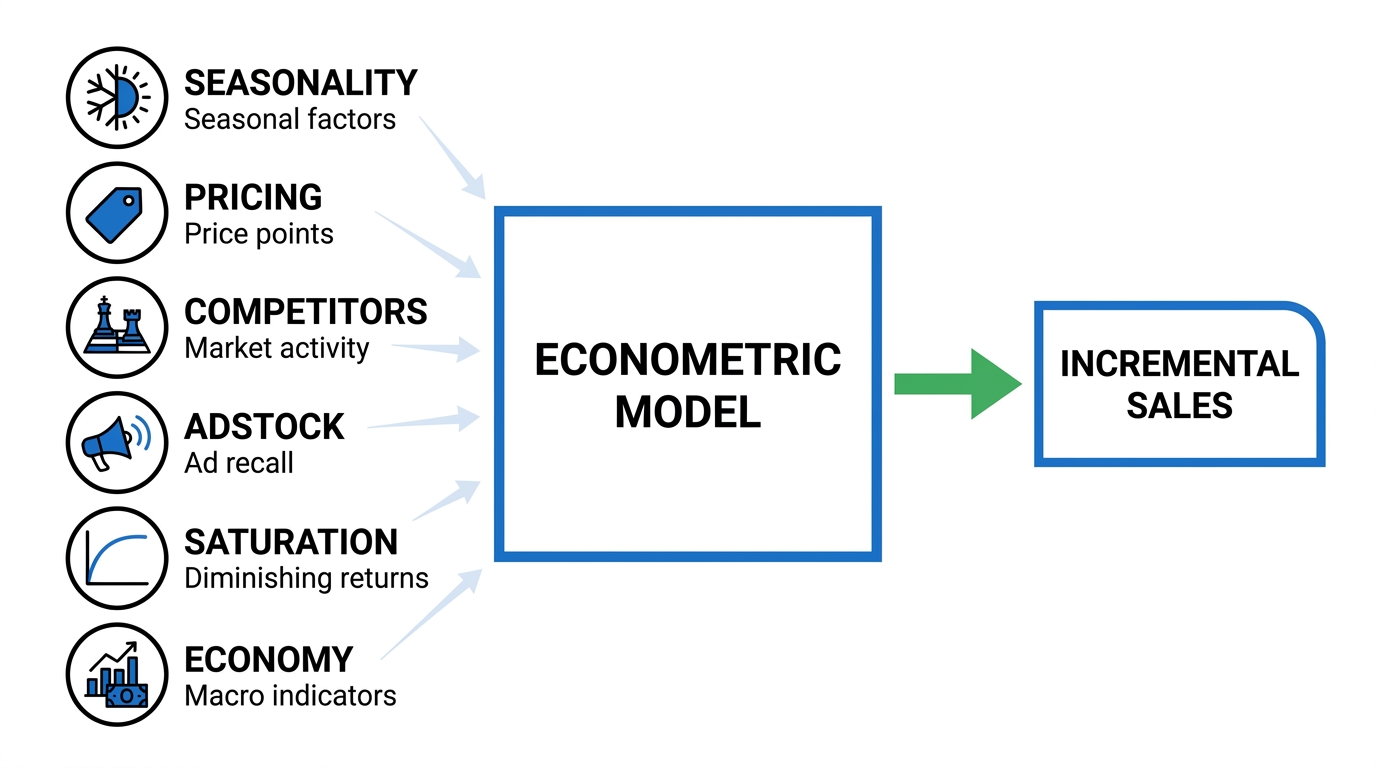
Econometric modeling uses multivariate regression to decompose sales into their constituent parts. It accounts for seasonality, price changes, competitor activity, and even macro factors like the economy. To capture the nuance of B2C marketing, these models use two core transformations to refine metrics to measure advertising effectiveness and ensure data accuracy.
Adstock and carryover effects
Marketing impact does not always happen instantly. Adstock measures how the effect of an ad persists over time, accounting for the "decay" of memory or influence. For example, a TV ad might have a decay rate of 0.6, meaning 60% of its impact carries into the following week.
$Adstock_t = Spend_t + theta times Adstock_{t-1}$
Saturation and diminishing returns
Every marketing channel has a ceiling where additional spend no longer produces the same level of results. Econometric models use a Hill function to find the point where returns begin to flatten, helping you identify the "sweet spot" for your budget.
$Effect = frac{Spend^alpha}{K^alpha + Spend^alpha}$
By applying these transformations, CEOs and CFOs can see exactly where to stop spending to avoid wasting budget on saturated channels.
Strategic versus tactical decision-making
The choice between incrementality and last-click is not a matter of one being "correct" and the other "wrong." Instead, it is about knowing which tool to use for specific decisions. For a media buyer, last-click provides the real-time velocity needed for keyword bidding and creative testing. It serves as a high-frequency signal for tactical adjustments.
For the CFO, CMO, and CEO, incrementality is the only reliable metric for budget allocation. Understanding incremental ROI vs platform ROAS is the key distinction. While a platform might claim a 4:1 ROAS, an econometric model might reveal the true incremental ROI is closer to 1.2:1 because many of those customers were already part of your organic baseline.
Adopting an incrementality-based framework allows B2C organizations to slash ad waste by up to 40%. By identifying channels that have reached saturation and reallocating that budget to under-utilized, high-growth areas, brands often see a 15% to 30% increase in revenue per marketing euro. Moving beyond the last click ensures that your media budget is actually moving the needle on your bottom line.
If you are ready to move from simple attribution to true causal measurement, explore our tailored solutions for marketers and executives to see how econometric modeling brings clarity to your media strategy.
Get Marketing Analytics Insights
Monthly briefings on marketing mix modeling, budget optimisation and what's actually moving the needle for European brands.


