How a marketing scenario planner optimizes your B2C budget
Analytical Alley Team
Marketing Analytics Experts
Are you still allocating budgets based on last year's spreadsheets and a gut feeling? Most B2C brands find that their top-performing channels are actually oversaturated, leading to wasted spend. A sce...
Are you still allocating budgets based on last year's spreadsheets and a gut feeling? Most B2C brands find that their top-performing channels are actually oversaturated, leading to wasted spend. A scenario planner uses econometrics to simulate "what-if" allocations, predicting outcomes with over 90% accuracy.
A marketing scenario planner serves as a strategic tool that leverages econometric forecasting to simulate various budget distributions. Unlike simple spreadsheets, it models the complex relationship between media spend, price elasticity, and external macro factors to predict sales and ROI.
The econometric engine behind the simulations
At its core, a scenario planner relies on marketing mix modeling to establish causality. It decomposes your total sales into two distinct categories to understand what actually drives growth:
By isolating these variables, the planner can test how reallocating funds from one channel to another might impact your total revenue. It accounts for diminishing returns, ensuring you do not overinvest in a channel that has already hit its saturation point.
Modeling diminishing returns and adstock
To provide realistic outcomes, econometrics uses specific mathematical transformations to mirror human behavior. These transformations prevent the model from assuming that every euro spent produces the same result regardless of volume or timing.
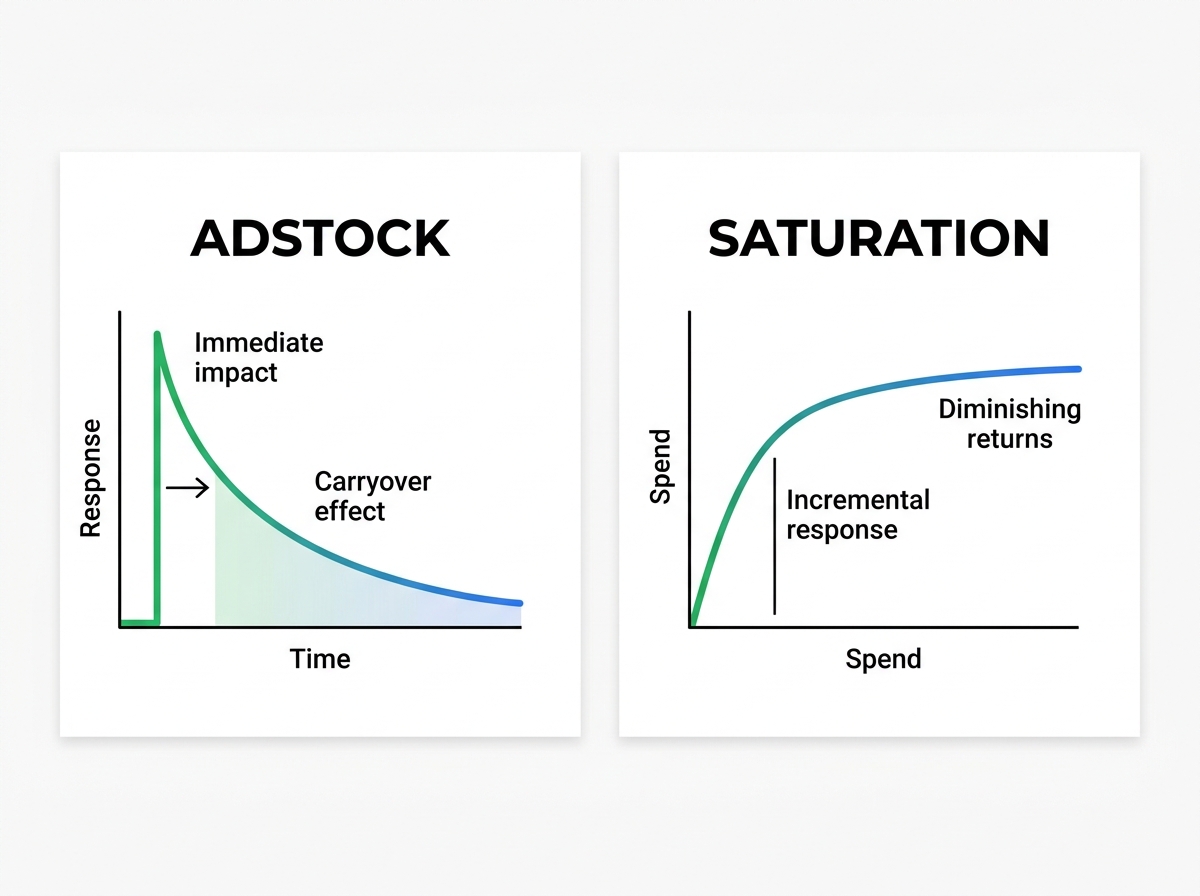
Adstock and carryover effects describe how marketing impact does not disappear the moment an ad stops running. Econometric models apply a decay factor to account for the halo effect of previous spend. This is often expressed as $Adstock_t = Spend_t + (theta times Adstock_{t-1})$, where $theta$ represents the retention rate of the advertisement's memory.
Saturation curves model the point where every additional euro spent generates less incremental revenue. This is frequently calculated using the Hill function:
$Effect = frac{Spend^alpha}{K^alpha + Spend^alpha}$
In this formula, $alpha$ represents the steepness of the curve and $K$ is the half-saturation point. A marketing scenario planner uses these curves to identify exactly when to stop spending on one channel and move to the next to maximize marketing spend optimization.
Marginal ROI vs. average ROI
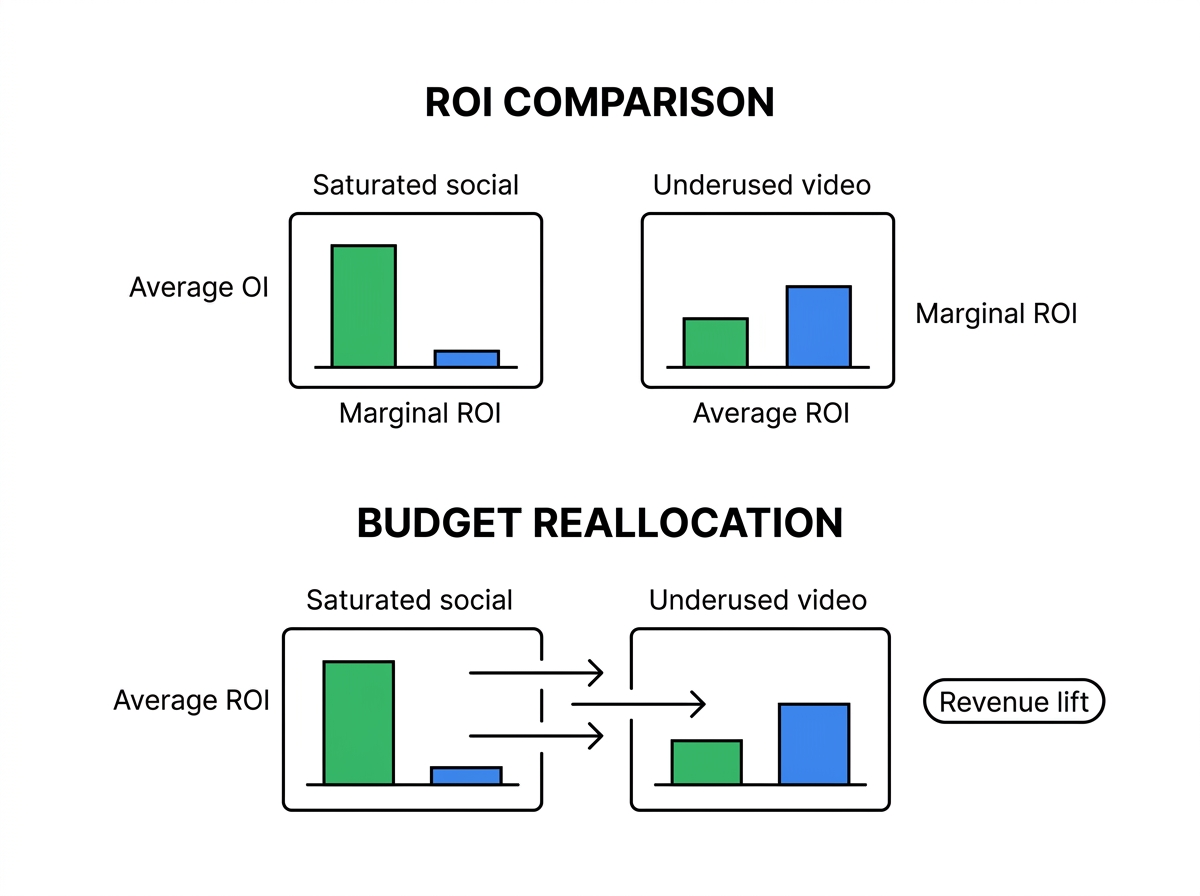
C-suite executives often make the mistake of looking at average ROI. If paid search shows a 5:1 return, it seems logical to spend more. However, a scenario planner focuses on marginal ROI, which is the return on the next euro spent.
While your average ROI might be high, your marginal ROI could be 1:1 if the channel is saturated. By equalizing marginal ROI across all channels, you can often lift revenue by 10% to 30% without increasing your total budget. Many B2C brands have achieved an 18% lift in incremental sales simply by shifting funds from saturated social media to underutilized display or video channels.
Stress-testing your strategy
A robust media budget scenario planning framework allows you to test your strategy against external shocks. You can build precise plans for business-relevant scenarios to evaluate tradeoffs before committing capital:
These simulations help executives move from reactive to proactive decision-making, helping to slash ad waste by up to 40% while maintaining growth targets.
Turning simulations into action
The goal of a scenario planner is not just to produce a report but to create a roadmap for marketers. Once the model identifies an optimal allocation, you can validate the findings through small-scale geo-tests or holdout experiments before rolling out the changes globally. This closed-loop process ensures the model stays calibrated to real-world responses.
By integrating these econometric insights into your quarterly planning cycles, you transform marketing from a cost center into a predictable driver of business value. You can see how these models have driven growth by exploring our case studies. If you are ready to stop guessing and start predicting your marketing outcomes, book a demo to see our mAI-driven scenario planner in action.
Get Marketing Analytics Insights
Monthly briefings on marketing mix modeling, budget optimisation and what's actually moving the needle for European brands.