How MMM helps B2C banks reduce ad waste by 40%
Analytical Alley Team
Marketing Analytics Experts
Did you know retail consumer banks face an average customer acquisition cost of $561? With rising competition and strict privacy regulations breaking traditional tracking, banking leaders need a measurement framework that captures the full customer journey without compromising compliance.
Did you know retail consumer banks face an average customer acquisition cost of $561? With rising competition and strict privacy regulations breaking traditional tracking, banking leaders need a measurement framework that captures the full customer journey without compromising compliance.
Why banking marketing requires econometrics
Consumer banking involves complex, multi-device journeys that often span several months. Whether a customer is researching a mortgage or looking for a new checking account, they rarely convert on the first click. Traditional digital attribution often misses 30% to 60% of actual marketing impact because it ignores offline influences and long consideration cycles. This measurement gap is particularly evident in Europe, where only 23% of marketers holistically measure their digital and traditional media spending.
Marketing mix modeling (MMM) solves this by using aggregated historical data rather than individual user tracking. Unlike platform-specific analytics, MMM is privacy-resilient and remains unaffected by the deprecation of cookies or iOS privacy changes. This makes it an ideal tool for financial institutions navigating GDPR and other regional regulations while seeking to understand the marketing mix modeling for financial services.
Solving the consideration cycle challenge
In banking, today's ad spend might not yield a conversion for several weeks. Econometric modeling uses mathematical transformations to account for these delays through techniques such as adstock and saturation curves. Adstock measures the carryover effect of marketing, recognizing that a TV spot seen today influences a decision made next month. Meanwhile, saturation identifies the point of diminishing returns where adding more budget to a channel like paid search no longer drives incremental growth.
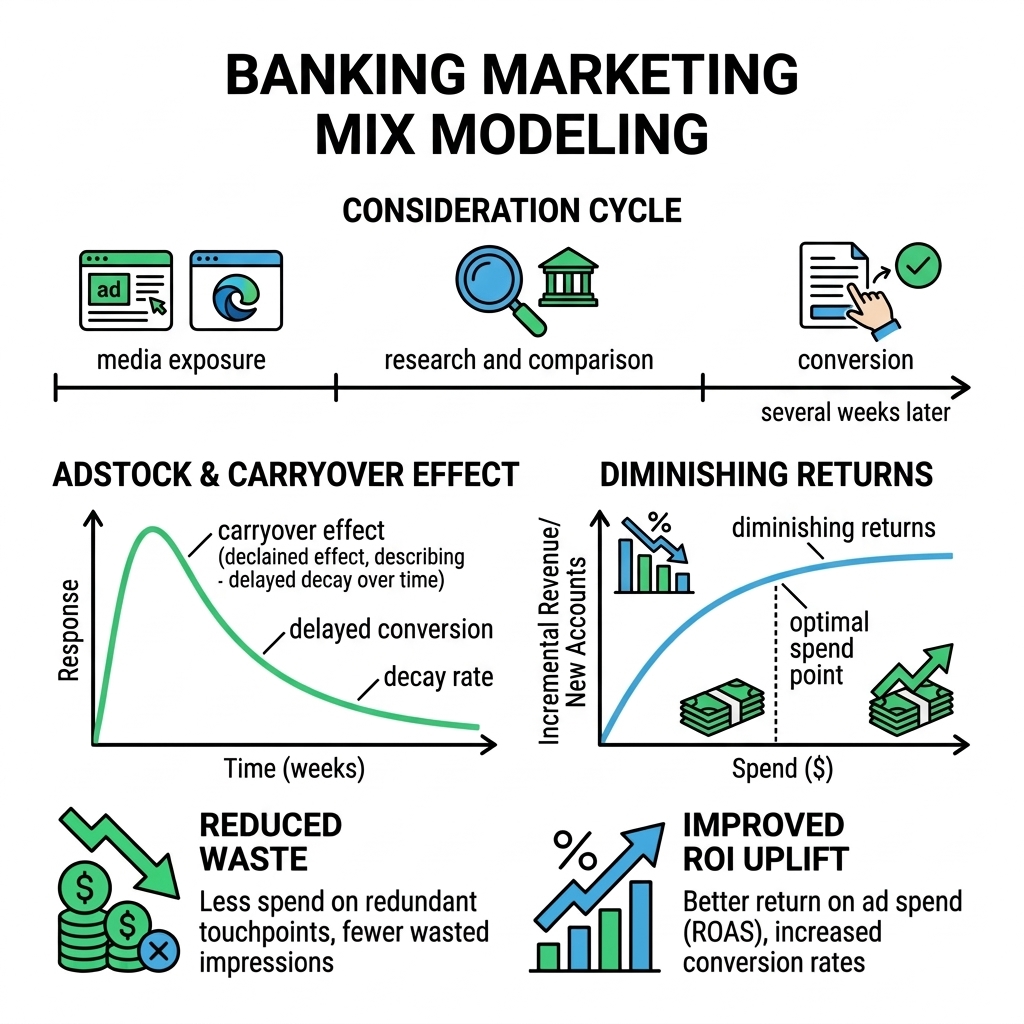
Models also control for external factors such as interest rate changes, seasonal holidays, and competitor actions to isolate the true impact of your media. The core logic follows a multivariable regression:
$Sales = Base + beta_{1}(Channel_{1}) + beta_{2}(Channel_{2}) + Seasonality + epsilon$
By quantifying these coefficients, you can move away from misleading platform ROAS and focus on true incremental growth. This approach provides the clarity needed to make actionable budget decisions based on historical performance rather than platform-biased data.
Proven results in European banking
Analytical Alley helps financial organizations across Scandinavia and the Baltics transform their media efficiency with a strategy that blends AI computing power and human insight. A prime example is Coop Pank, which used this approach to navigate a competitive market. By implementing a comprehensive model, they exceeded their growth targets by 26% while actually spending 0.5% less than their planned budget. These results are detailed further in our overview of banking case studies.
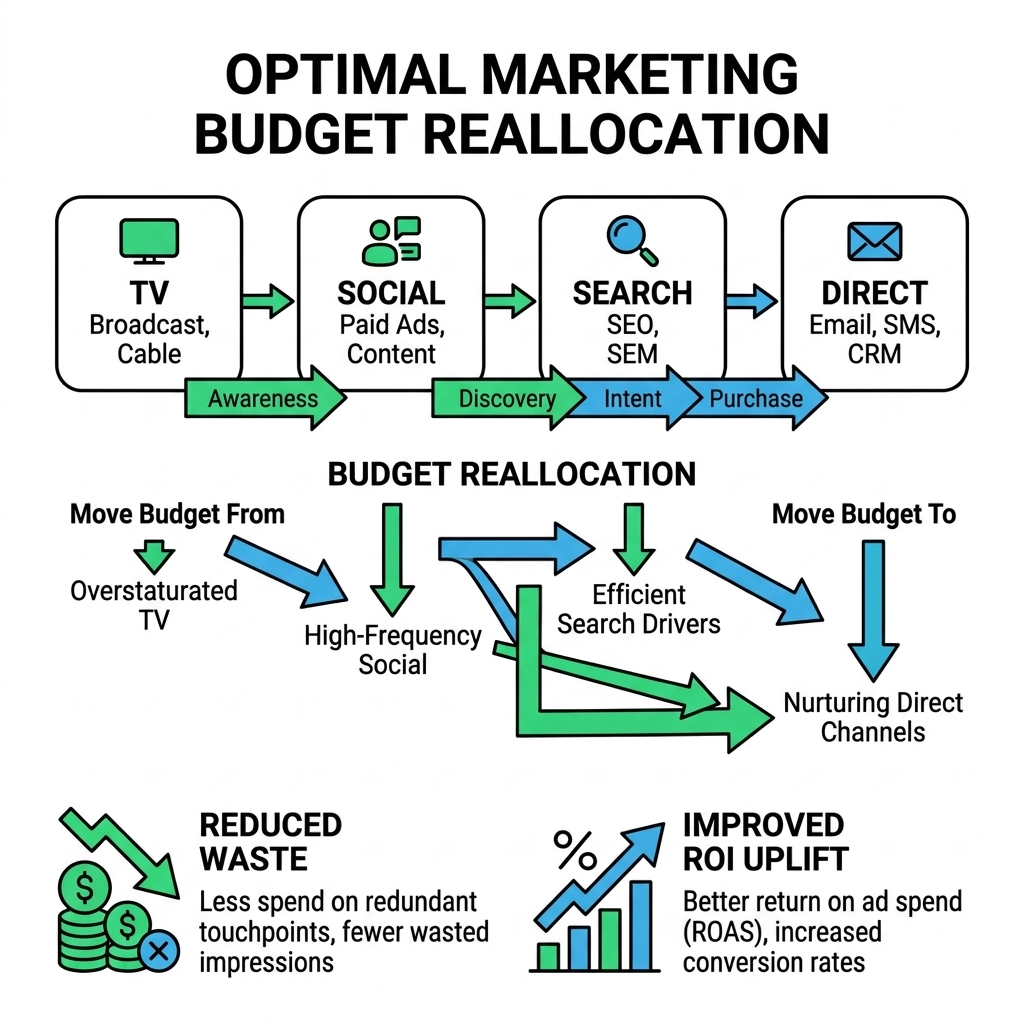
This methodology allows marketers to slash ad waste by up to 40% by identifying which channels truly drive results. Instead of guessing, you can run simulations to see how shifting budget between channels might impact your bottom line. Our model predicts the impact of marketing and macro variables with over 90% accuracy, bringing together aspects you used to see in isolation.
Strategic allocation versus tactical refinement
While MMM provides the macro-level view for budget setting, it works best when paired with tactical testing. You can use econometrics to decide the total investment for each channel and then utilize lift testing to refine specific campaign elements. This ensures that executives have a clear view of ROI while the media team has the data needed for daily optimizations.
This hybrid approach allows you to address different business needs simultaneously:
You can read more about how these methodologies complement each other in our guide on econometrics vs attribution.
Optimize your banking media spend
Marketing mix modeling provides a privacy-safe roadmap for your financial marketing strategy. By moving beyond last-click metrics and accounting for the unique challenges of the banking sector, you can ensure every euro spent contributes to measurable growth.
Ready to see how our mAI-driven media strategy can improve your ROI? Book a demo today to discover where your budget works hardest.
Get Marketing Analytics Insights
Monthly briefings on marketing mix modeling, budget optimisation and what's actually moving the needle for European brands.