Marketing mix modeling for small datasets: how to measure B2C impact
Analytical Alley Team
Marketing Analytics Experts
Are you waiting for "perfect" data before measuring marketing incrementality? You do not need a decade of history to benefit from econometrics. With 18 to 24 months of data, B2C brands can accurately ...
Are you waiting for "perfect" data before measuring marketing incrementality? You do not need a decade of history to benefit from econometrics. With 18 to 24 months of data, B2C brands can accurately isolate channel impact and slash ad waste by up to 40%.
The minimum data requirements for small-scale MMM
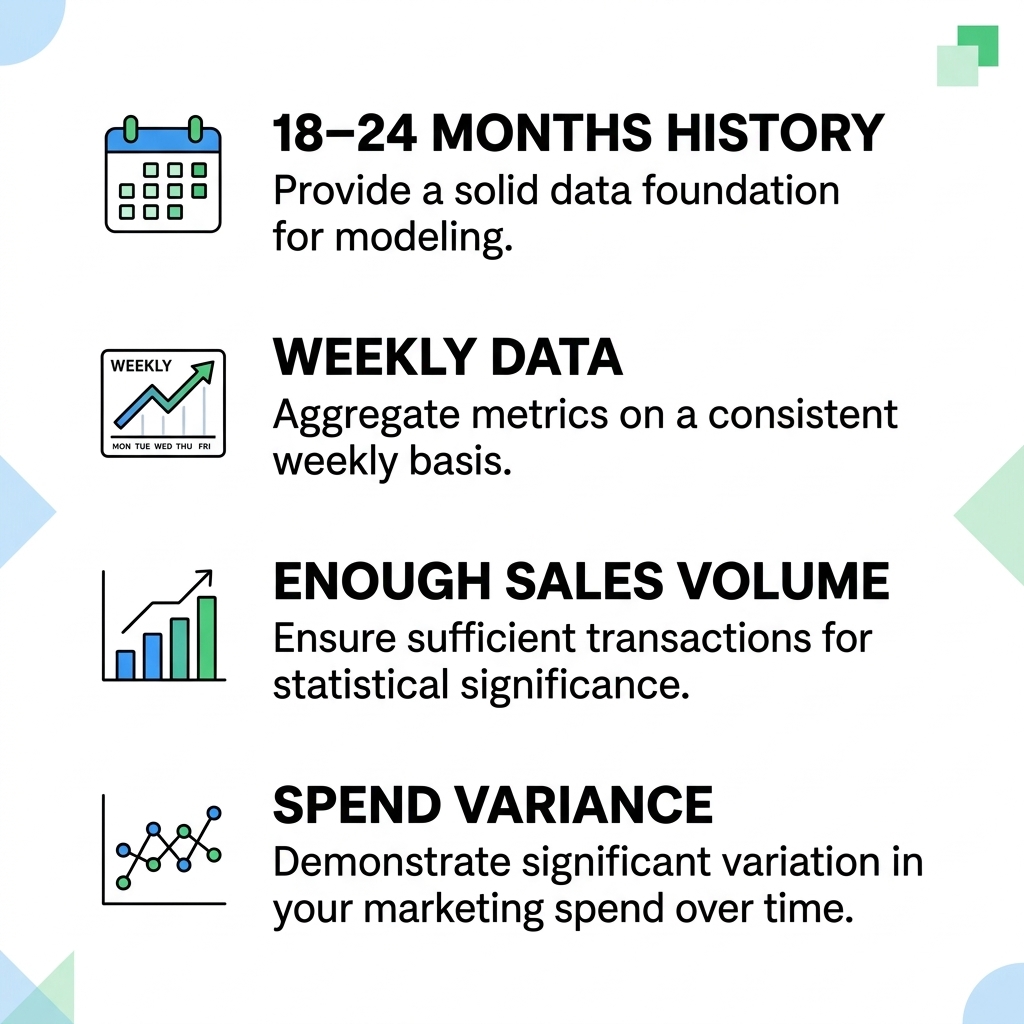
Many marketing strategists and CFOs believe that marketing mix modeling (MMM) is reserved for global giants with massive data lakes. However, the viability of a model depends more on the quality and variance of your data than the sheer volume. For a robust marketing mix modeling exercise in a B2C context, your organisation needs to meet specific benchmarks to ensure statistical power and reliability.
Strategies to overcome limited data
When data is sparse, the risk of overfitting or multicollinearity in marketing data increases. This occurs when variables are so closely related that the model cannot distinguish which one is actually driving the result. To maintain our standard of 90% and above prediction accuracy, we use specific econometric techniques to stabilise the results and ensure the insights remain actionable.
Instead of trying to model every single sub-campaign, we group activities into 5 to 10 key channels. For example, you might aggregate all TV channels into a single "TV" variable. This reduces the number of parameters the model needs to estimate, which naturally increases the reliability of the output for smaller datasets.
In smaller datasets, the mathematical output might occasionally suggest that a channel has a negative ROI, which is logically impossible for active marketing. We apply logical constraints and priors to guide the algorithm toward realistic outcomes. These are often based on industry benchmarks or previous results seen when measuring incrementality through other testing methods.
Even with limited data, the model must account for "Base Sales," which are the transactions that would happen without any marketing influence. We use a regression equation to visualise the relationship:
$Sales = Base + beta_{1}(Spend_{1}) + beta_{2}(Spend_{2}) + Seasonality + epsilon$
By accurately modeling seasonality and external economic factors, we ensure that the marketing coefficients ($beta$) are not taking credit for organic growth, holiday peaks, or competitor lulls but for incremental impact only.
The trade-offs of modeling with less data
It is important for CEOs and CMOs to understand that smaller datasets involve a trade-off in granularity. While a large-scale model might identify the ROI of a specific creative on one platform, a small-data model is designed for high-level strategic questions.
Triangulating for maximum precision
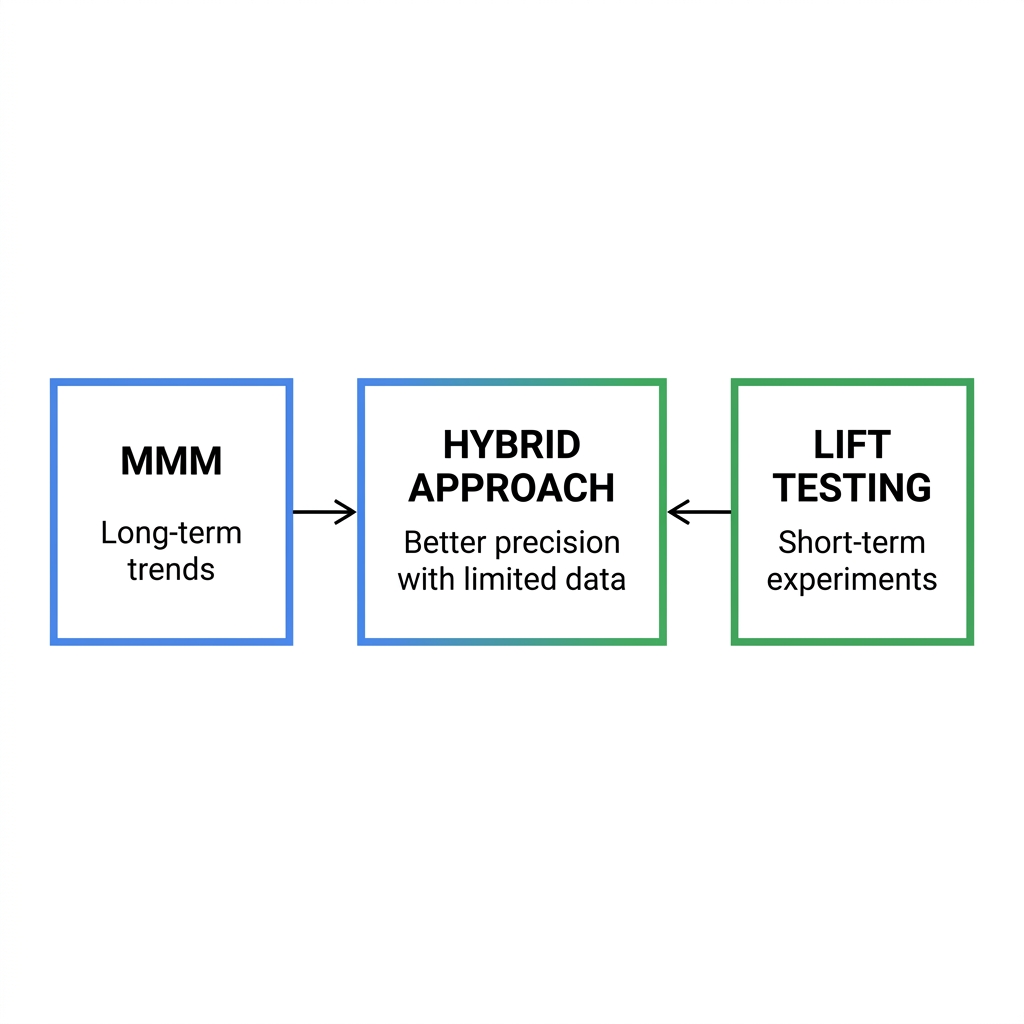
To compensate for a limited historical dataset, we recommend a hybrid approach. By combining MMM plus lift testing, you can use the results of short-term experiments to calibrate the econometric model. This reduces uncertainty and provides a more rounded view of performance that balances long-term trends with immediate results.
If your organisation is still using last-click metrics because you feel your data history is too short, you are likely over-investing in bottom-funnel channels and missing the broader picture. You can evaluate your current readiness by using a marketing data maturity assessment to see how to bridge the gap from basic tracking to advanced econometrics.
Small datasets are not a barrier to professional measurement; they simply require a more tailored and expert approach. By focusing on aggregated channel impact and controlling for seasonality, you can stop guessing and start optimising your B2C media mix.
See our solutions for marketers to learn how we help brands in Scandinavia and the Baltics turn limited data into clear, actionable budget decisions. If you are ready to see how our mAI-driven strategy works in practice, book a demo today.
Get Marketing Analytics Insights
Monthly briefings on marketing mix modeling, budget optimisation and what's actually moving the needle for European brands.