MMM vs GA4 attribution: how to optimize B2C marketing spend
Analytical Alley Team
Marketing Analytics Experts

Why does GA4 report a high return on investment while your total revenue remains flat? Understanding the methodological gap between user-level attribution and econometric modeling is the only way to s...
Why does GA4 report a high return on investment while your total revenue remains flat? Understanding the methodological gap between user-level attribution and econometric modeling is the only way to stop overspending on saturated channels. This guide clarifies how to balance tactical signals with strategic growth.
Methodological foundations: aggregate vs individual data
The fundamental difference between Marketing Mix Modeling (MMM) and GA4 attribution starts with the data. GA4 operates at the individual user level by tracking specific events and touchpoints through cookies and identifiers. While this offers a granular view of digital journeys, it is increasingly vulnerable to signal loss from ATT opt-outs and cookie blocking.
MMM uses aggregate, time-series data instead of individual tracking. By analyzing 18 to 36 months of historical observations across all channels, it remains inherently privacy-compliant. This approach accounts for offline media and external economic factors that GA4 simply cannot see, making it immune to the limitations of consent mode restrictions.
Distinguishing base sales from incremental lift
For B2C executives, the distinction between a conversion and a truly incremental sale is vital. GA4 attribution typically assigns 100% of a conversion's credit to the digital touchpoints it identifies within a fixed lookback window. This logic often over-attributes credit to bottom-funnel channels like paid search or retargeting.
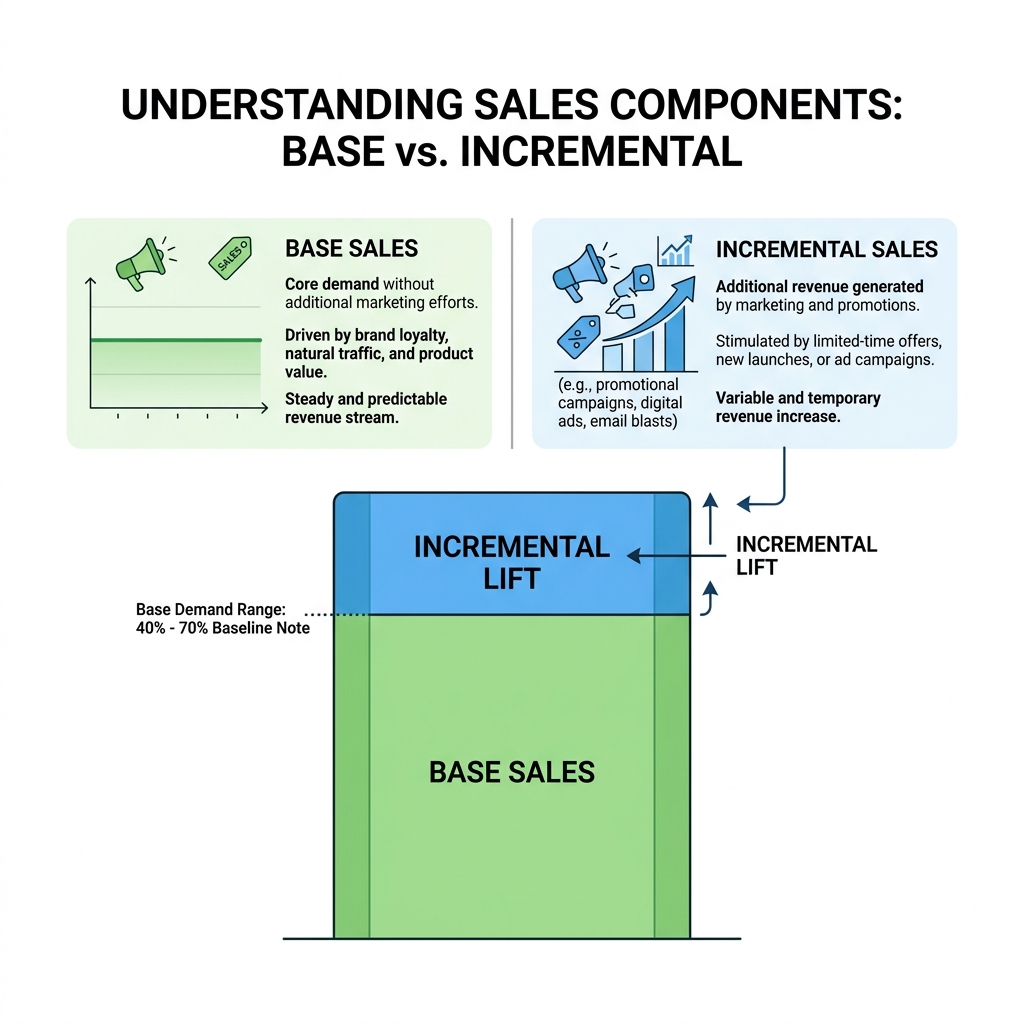
In contrast, base vs incremental sales analysis allows marketers to separate organic demand from marketing impact. Base sales are the transactions that would occur without any advertising, often driven by brand equity, pricing, or physical availability. In most B2C sectors, this baseline accounts for 40% to 70% of total revenue. By isolating incremental ROI, MMM reveals the true efficiency of your media spend rather than reflecting existing demand.
Time horizons and the math of marketing impact
GA4 uses linear or data-driven models that view marketing impact as immediate. It fails to account for the carryover effects of brand-building or the reality of diminishing returns. To solve this, marketing spend optimization techniques model how marketing works over several periods.
Adstock transformations capture how today's advertising impacts future sales. For example, a TV campaign might peak two weeks after the initial airing. This is expressed mathematically:
$Adstock_t = Spend_t + (theta times Adstock_{t-1})$
The model also identifies saturation points where spending more on a channel no longer produces proportional gains. This is calculated using saturation curves:
$Effect = frac{Spend^alpha}{K^alpha + Spend^alpha}$
By identifying these curves, optimization becomes a matter of shifting budget to channels with the highest marginal return rather than just looking at the highest average return.
Strategic vs tactical application
The most effective measurement strategy uses both tools in a hybrid approach. Marketing strategists should use GA4 for tactical tasks like A/B testing ad creatives, monitoring real-time performance of digital campaigns, and optimizing granular keyword bids. These signals are perfect for inter-channel adjustments where speed is essential.
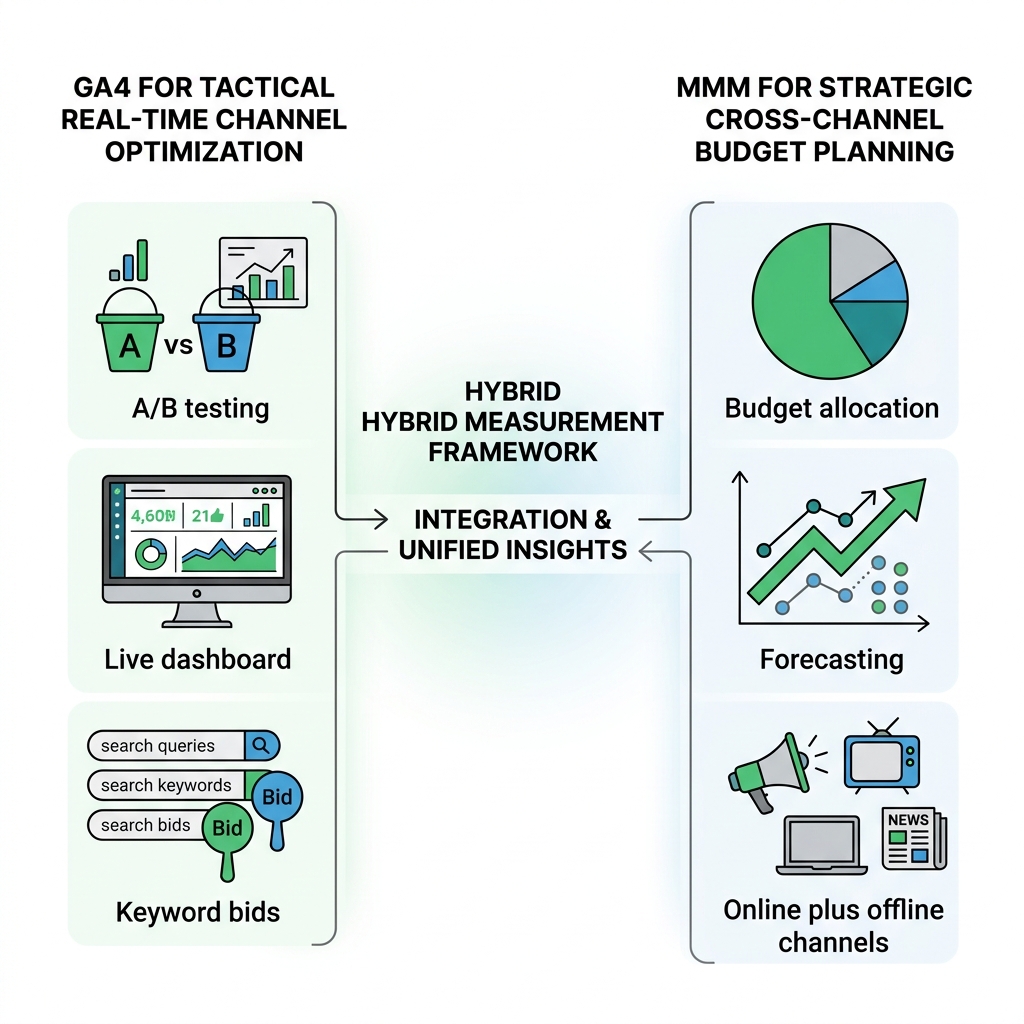
Comparing the two frameworks in econometrics vs attribution highlights their specific roles. GA4 provides tactical, real-time optimization for digital channels. MMM offers a unified framework for both online and offline media, including TV, OOH, print ads and others. While GA4 ignores external factors like seasonality and economic shifts, MMM incorporates these as variables to provide a more accurate picture of performance.
Marketing mix modeling should be the primary tool for media budget scenario planning and cross-channel reallocation. It is the most reliable way of measuring incrementality and proving marketing value to the C-suite.
Analytical Alley combines AI computing power with human insight to build multivariable models that predict the impact of your marketing with over 90% accuracy. Our approach helps B2C organizations slash ad waste by up to 40% by revealing where your budget actually drives growth. To see how econometric modeling can clarify your performance analysis and optimize your cross-channel spend, explore our solutions for marketers and executives.
Get Marketing Analytics Insights
Monthly briefings on marketing mix modeling, budget optimisation and what's actually moving the needle for European brands.