Fix multicollinearity to stop wasting B2C ad spend
Analytical Alley Team
Marketing Analytics Experts

Are your marketing attribution models showing sudden, chaotic shifts in channel ROI? When multiple B2C campaigns launch simultaneously, correlated data can cloud your budget decisions and lead to cost...
Are your marketing attribution models showing sudden, chaotic shifts in channel ROI? When multiple B2C campaigns launch simultaneously, correlated data can cloud your budget decisions and lead to costly mistakes.
Understanding multicollinearity in B2C marketing
Multicollinearity occurs in marketing mix modeling when two or more marketing variables move together in highly correlated patterns. When this happens, it becomes statistically difficult or impossible for a regression model to separate their individual effects on outcomes like sales or revenue.
For B2C brands, this is an incredibly common challenge. For example, if you launch a major TV campaign and simultaneously scale up your paid search and social media budgets, all three channels will spike at the same time. Because these data points rise and fall in tandem, standard statistical models cannot accurately determine which channel actually drove the resulting sales increase.
The financial cost of uncorrected collinear data
When multicollinearity is left unaddressed in your analytics, it introduces severe risks for marketing strategists, media buyers, and C-suite executives:
To make confident decisions, decision-makers need strategic dashboards and executive tools built on modeling frameworks where every marketing lever is isolated and measured accurately.
Diagnostics to detect collinearity in B2C datasets
Before attempting to fix your models, your analytics team must diagnose the severity of the correlation. There are three standard diagnostic metrics used in marketing mix modeling data science processes:
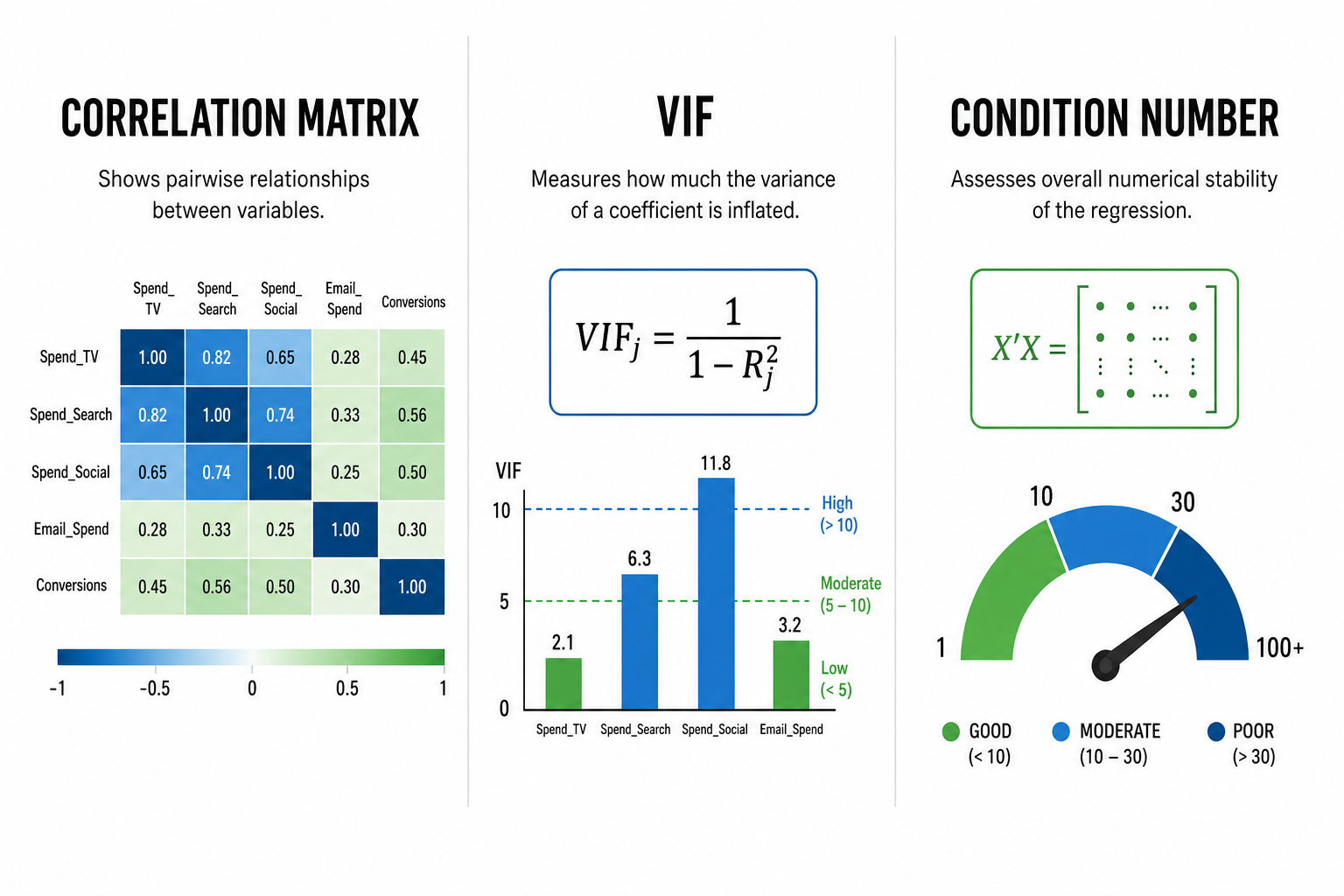
Correlation matrix
A simple correlation matrix maps how variables move in relation to one another. A correlation coefficient close to $1$ or $-1$ is a strong indicator of positive or negative collinearity between two specific media channels, suggesting they are moving too closely to separate easily.
Variance Inflation Factor
The Variance Inflation Factor (VIF) quantifies how much the variance of an estimated coefficient is inflated because of correlation with other variables. The formula for VIF is:
$$VIF _i = frac{1}{1 - R_i^2}$$
As a general rule of thumb, VIF values above 10 indicate severe multicollinearity that requires immediate intervention to protect model validity.
Condition number
This metric evaluates the overall stability of the regressor matrix. If the condition number of your data matrix exceeds 20, the model is likely to encounter numerical instability, meaning even tiny data entry variations can drastically alter the final attribution results.
Proven econometric solutions for multicollinearity
If your diagnostics reveal high multicollinearity, several proven econometric adjustments can restore the integrity of your models. You can read more about these fundamental concepts in our guide on multicollinearity in marketing data.
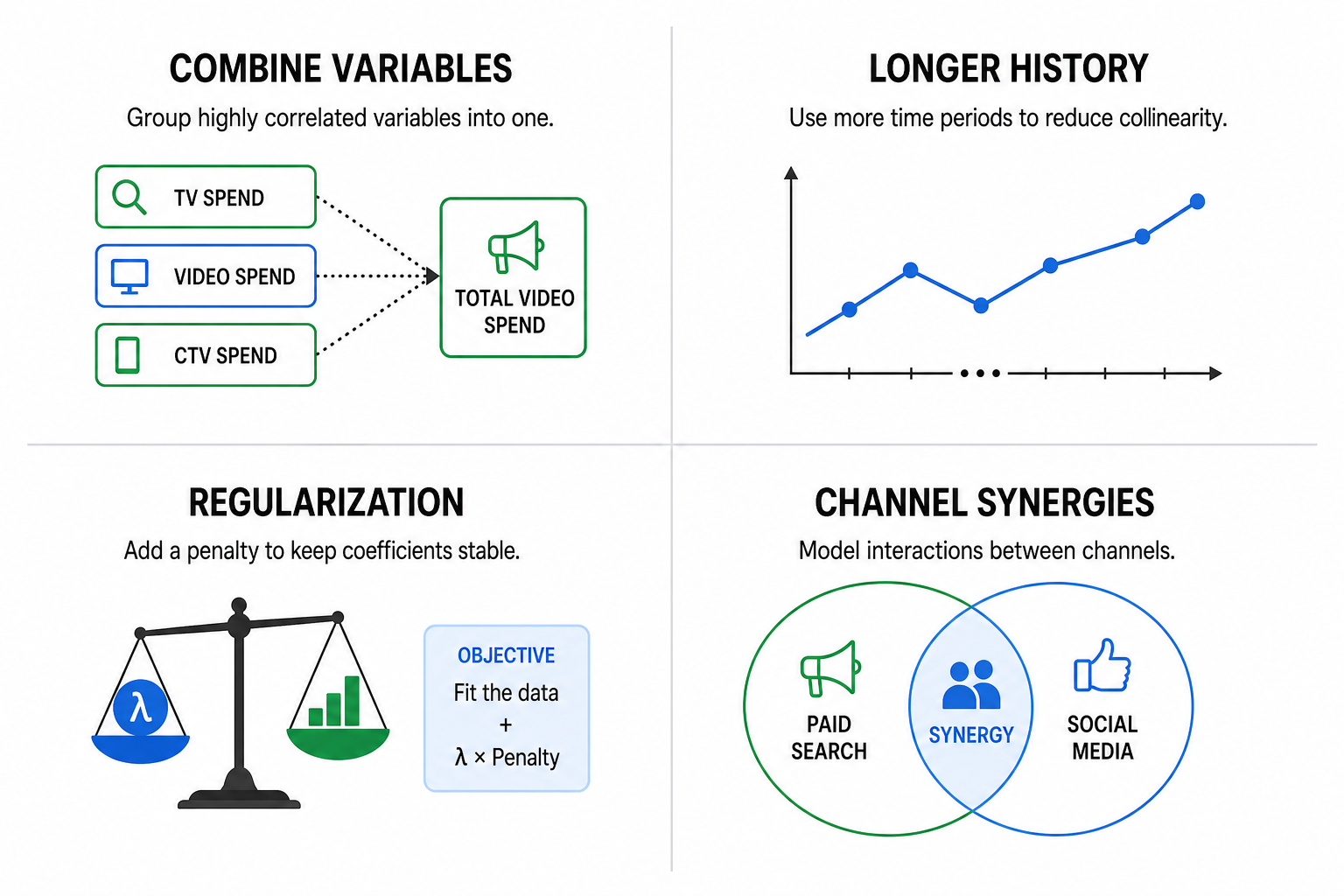
Stabilizing your media mix models for reliable growth
Resolving multicollinearity is not just a technical box to check: it is a fundamental requirement for making smart, calculated budget decisions. When you remove statistical noise from your marketing data, you gain a clear, uncompromised view of your actual marketing performance.
For growth-focused solutions for marketers and media buyers, this clarity means eliminating budget waste and scaling the channels that truly drive incremental growth. For technical leaders who implement solutions for data scientists, resolving these correlations ensures that every model delivered to the C-suite is statistically robust and ready to guide strategic planning.
To see how clean data and advanced econometric modeling can transform your marketing ROI, explore our platform or connect with our team today to build a stable, high-accuracy measurement framework for your brand.
Get Marketing Analytics Insights
Monthly briefings on marketing mix modeling, budget optimisation and what's actually moving the needle for European brands.