How randomized controlled trials isolate causal marketing impact
Analytical Alley Team
Marketing Analytics Experts
Are you paying for sales that would have happened anyway? Most platform metrics claim credit for organic conversions, but randomized controlled trials (RCTs) isolate the true causal impact of your bud...
Are you paying for sales that would have happened anyway? Most platform metrics claim credit for organic conversions, but randomized controlled trials (RCTs) isolate the true causal impact of your budget. This econometric approach ensures you only invest in ads that drive incremental growth.
The gold standard of causal measurement
In an era of signal loss and privacy regulations, traditional attribution often confuses correlation with causation. Randomized controlled trials solve this by splitting your audience into a treatment group, which sees your ads, and a control group, which does not. This is the most reliable way to establish a direct link between spend and outcomes.
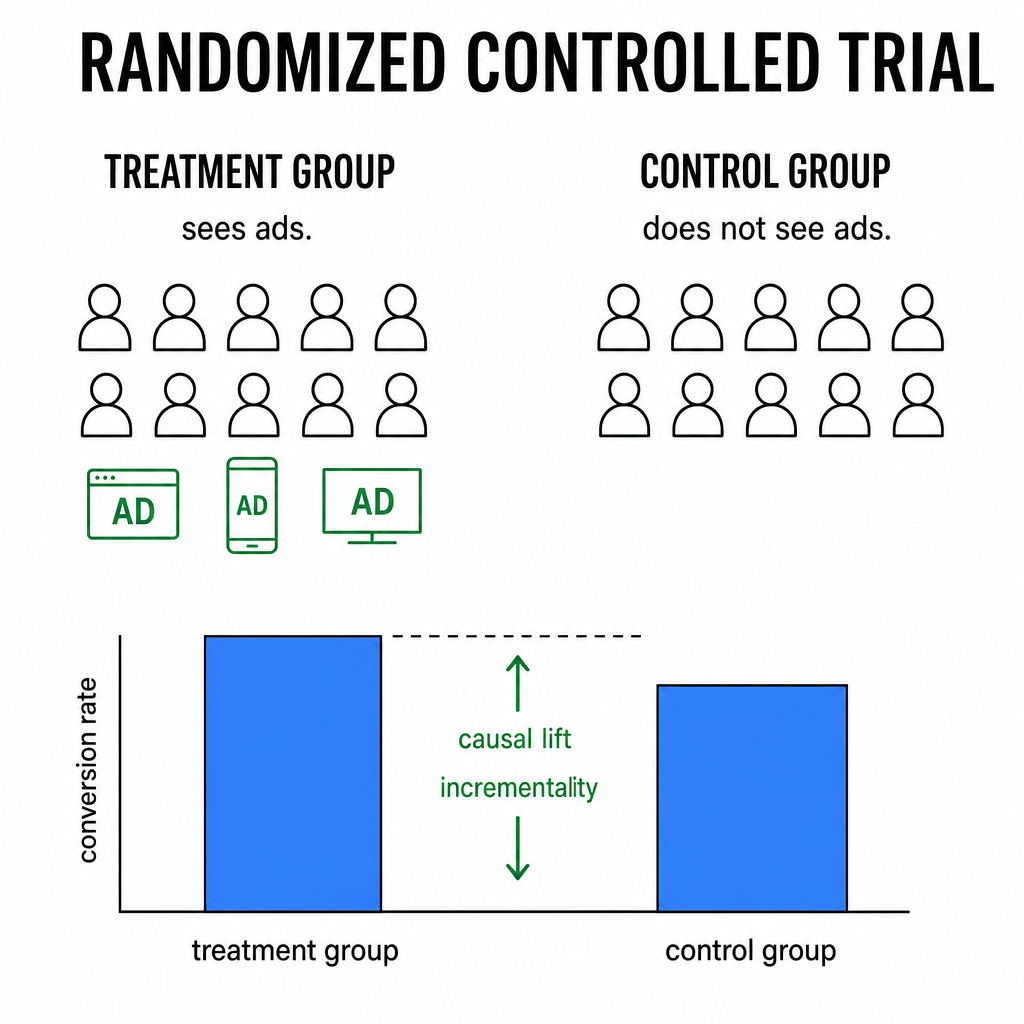
By comparing the behaviour of these two groups, you can calculate the true incrementality of your marketing efforts. This method is the only way to account for your business baseline, which typically represents 40% to 70% of your total sales. Without RCTs, you risk over-attributing revenue to channels like brand search or retargeting that often cannibalise organic traffic.
Types of marketing experiments
There are three primary ways to deploy RCTs in a B2C context to gain a clear view of your advertising performance:
Triangulating RCTs with marketing mix modeling
While RCTs provide the ground truth for specific campaigns, they are often difficult to run continuously across every channel. This is where econometrics becomes essential for a holistic strategy. Modern marketing mix modeling uses historical data and multivariable regression to provide a comprehensive view of your performance across all media.
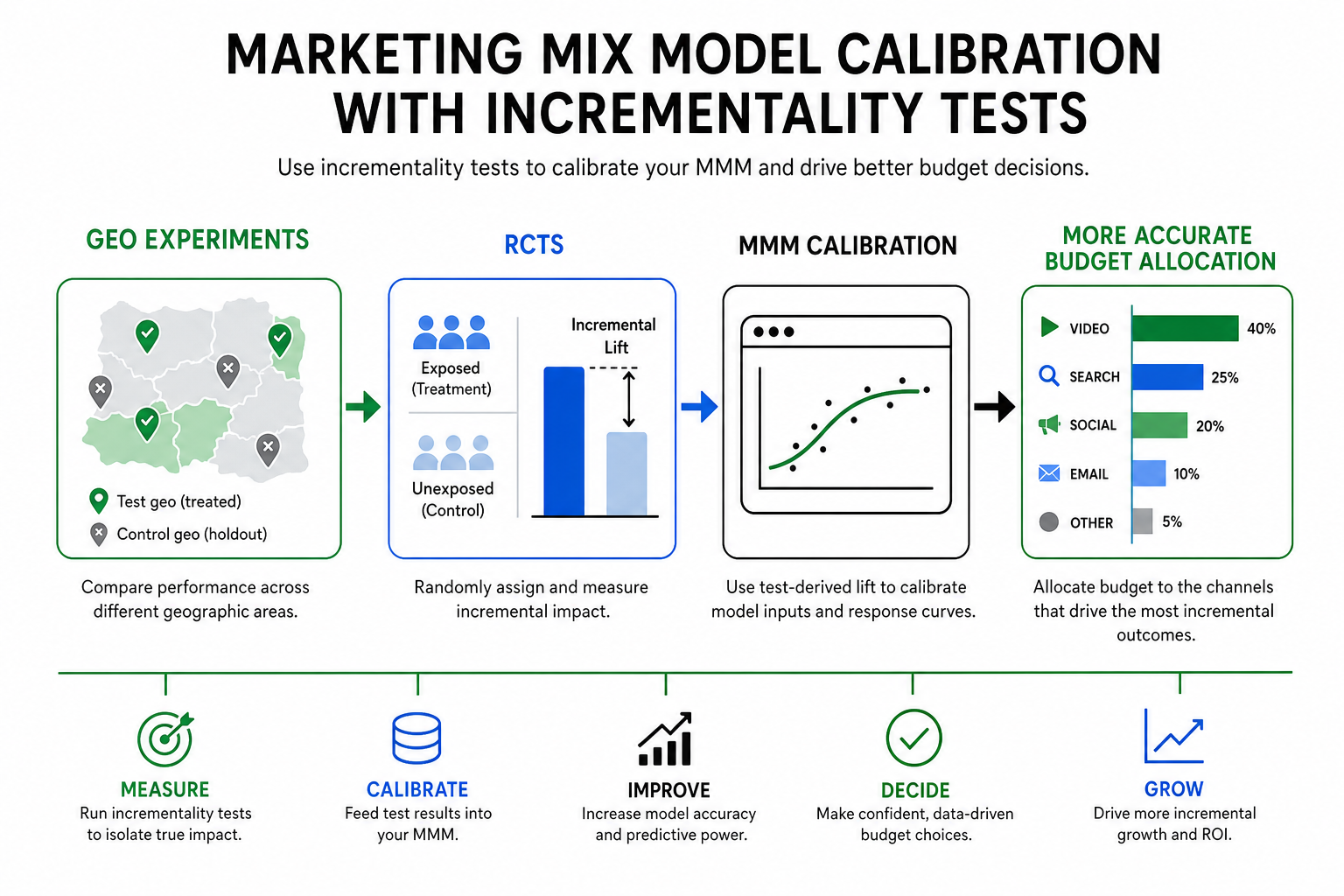
Best practices for marketing strategists involve using RCT results to calibrate their MMM. By feeding experimental lift data into the model, you can align your longitudinal econometric estimates with experimental evidence. This hybrid approach allows you to validate model-based incrementality estimates with causal evidence while generalising findings from a single test across different geographies and time periods. It also helps you identify diminishing returns and saturation points more accurately.
Why the C-suite requires experimental evidence
For CFOs and CEOs, marketing is often seen as a cost center because of opaque reporting. RCTs transform marketing into a predictable investment by providing a margin-based ROI that the finance department can trust. This level of transparency is vital for making large-scale budget decisions.
Implementing a rigorous testing culture can help organizations slash ad waste by up to 40%. Instead of looking at reported ROAS, which is often inflated by self-attribution bias, executives can focus on incremental return on ad spend (iROAS). This metric tells you exactly how many additional euros of revenue were generated for every euro spent, net of the sales that would have happened regardless of your advertising activity.
Implementing a test and learn roadmap
To move toward a data-driven measurement stack, start by auditing your current channels for hidden waste. Focus your first RCTs on high-spend areas where brand lift studies vs MMM show the greatest discrepancy in reported performance. This often reveals significant opportunities for immediate budget reallocation.
Once you establish a baseline of incremental lift, integrate these findings into your marketing effectiveness framework. Continuous testing, combined with a multivariable model capable of over 90% prediction accuracy, ensures your budget is always allocated to the highest marginal return.
Stop guessing which parts of your budget are working and start measuring the real impact of your spend. At Analytical Alley, we help you combine human insight with AI power to eliminate waste and drive growth.
Get Marketing Analytics Insights
Monthly briefings on marketing mix modeling, budget optimisation and what's actually moving the needle for European brands.