How to stop wasting 40% of your budget by quantifying marketing data ROI
Analytical Alley Team
Marketing Analytics Experts
Are you certain your platform-reported ROAS isn't just claiming credit for organic sales? Most B2C brands unknowingly waste 40% of their advertising spend due to fragmented data and misleading attribu...
Are you certain your platform-reported ROAS isn't just claiming credit for organic sales? Most B2C brands unknowingly waste 40% of their advertising spend due to fragmented data and misleading attribution models that fail to isolate true business impact.
Why traditional attribution distorts business value
Most marketing teams calculate returns based on last-click or multi-touch attribution (MTA). These models systematically overstate search ROI by 50% to 80% because they fail to account for baseline sales: the revenue your brand would generate even if you stopped advertising tomorrow. In European markets, strict privacy regulations like GDPR and signal loss from iOS ATT mean platform reports often miss between 30% and 60% of the actual marketing impact.
To prove the genuine business value of your investments, you must move beyond a digital marketing return on investment based purely on online interactions. Causal measurement is required to distinguish between shoppers who were influenced by an ad and those who were already on a path to purchase. Without this distinction, your data likely encourages over-investment in bottom-funnel tactics while starving the brand-building channels that drive long-term growth.
Measuring incrementality through econometrics
Econometric modelling, frequently referred to as marketing mix modeling, uses aggregate historical data to determine the causal relationship between media spend and revenue. Unlike user-level attribution, this approach controls for external factors such as seasonality, competitor pricing, and macro-economic shifts.
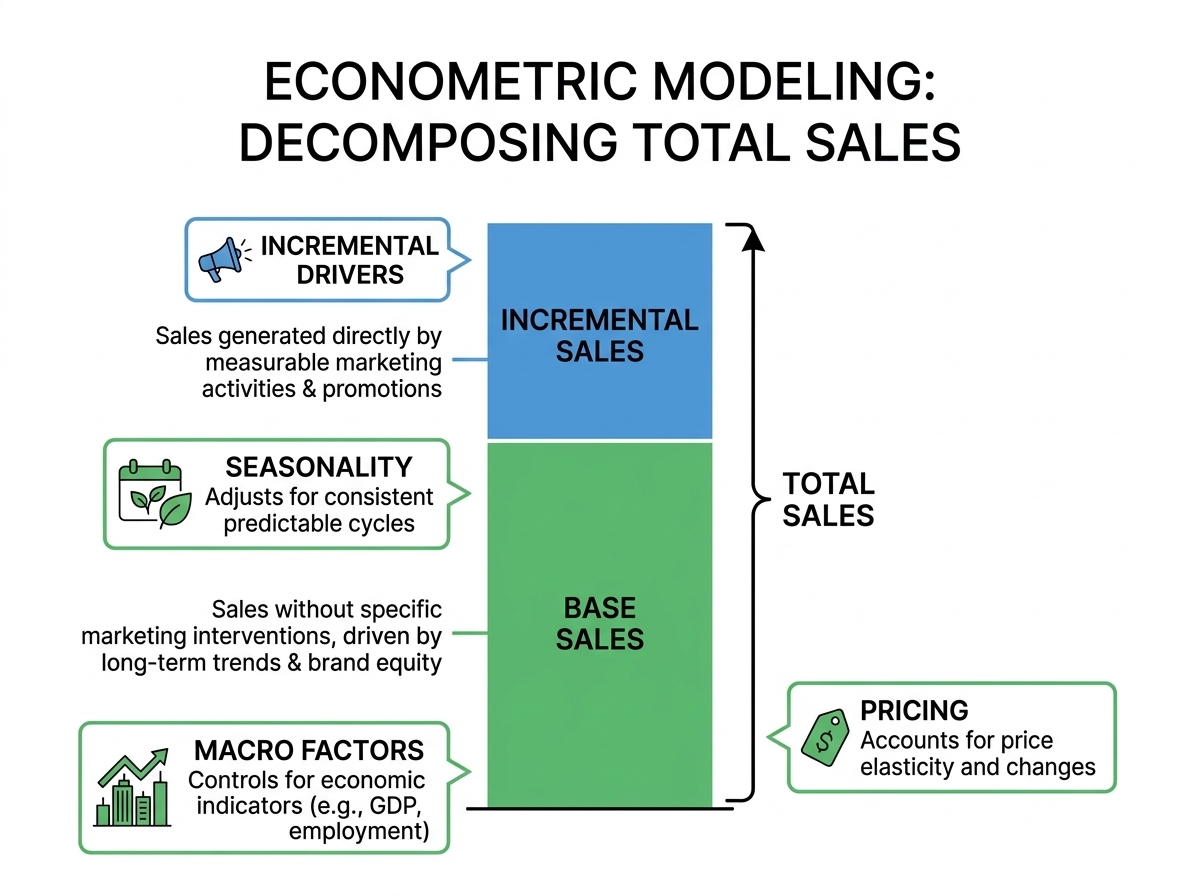
Quantifying value through this lens requires separating your sales into two distinct categories:
The fundamental incremental ROI vs platform ROAS calculation focuses exclusively on the revenue that would not have existed without the campaign:
$$ROI = frac{text{Incremental Revenue} - text{Marketing Cost}}{text{Marketing Cost}}$$
Moving from average ROI to marginal ROI
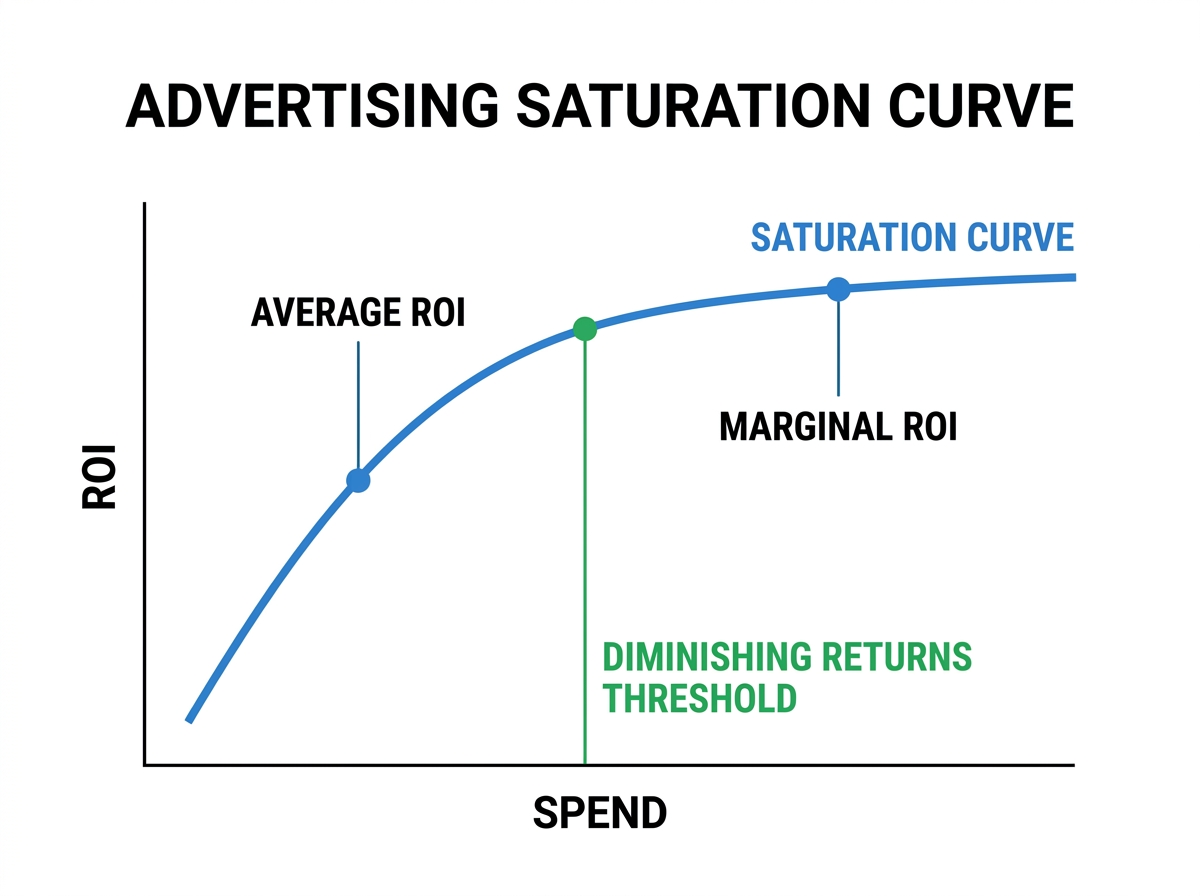
A common pitfall for C-suite executives is making budget decisions based on average ROI. If your paid search shows a 4:1 return, it is tempting to increase the budget indefinitely. However, every channel eventually hits a point of diminishing returns where the next euro spent yields significantly less than the previous one. For example, Meta ROI can drop from 2.8:1 to 1.4:1 once spending exceeds a specific threshold, such as €100,000.
Econometric models use saturation curves to identify marginal ROI, which is the return on the very next euro invested. While your average return might remain high, a low marginal ROI indicates that you are over-saturating a channel. By simulating marketing spend optimization scenarios, organizations can reallocate spend from saturated channels to underfunded ones like YouTube or TV, often achieving efficiency gains of 20% to 30% without increasing the total budget.
The financial impact of data-driven modeling
Quantifying the value of marketing data is fundamentally about reducing risk and identifying wasted capital. Using an econometric framework allows leadership to move from defensive reporting to proactive financial planning. A mAI-driven approach provides several key advantages:
Strategic steps for executives and strategists
To transform your marketing data into a clear ROI calculation that satisfies both the marketing department and the finance office, you should prioritize the following actions:
We turn complex business data into clear, actionable budget decisions that drive real growth. Whether you are a media buyer looking to optimize specific tactics or a CFO requiring solutions for executives that prove marketing effectiveness, econometric modeling provides the transparency required for modern B2C leadership.
Find out which channels truly drive results and where your money works best. Book a demo to see how our mAI-driven strategy can optimize your media performance and slash ad waste.
Get Marketing Analytics Insights
Monthly briefings on marketing mix modeling, budget optimisation and what's actually moving the needle for European brands.