The death of attribution: why B2C brands are shifting to MMM
Analytical Alley Team
Marketing Analytics Experts
Is your reported ROAS actually delivering profit or just claiming credit for organic sales? As privacy regulations and signal loss erode traditional tracking, the gap between platform data and busines...
Is your reported ROAS actually delivering profit or just claiming credit for organic sales? As privacy regulations and signal loss erode traditional tracking, the gap between platform data and business reality has never been wider for modern marketers.
The traditional measurement landscape is undergoing a structural collapse. For years, B2C marketers relied on last-click attribution and multi-touch models (MTA) to justify ad spend. However, the combination of Apple’s ATT, the phase-out of third-party cookies, and increasingly complex customer journeys has rendered these user-level tracking methods unreliable.
The breakdown of user-level tracking
Traditional attribution relies on a continuous digital trail that no longer exists in its entirety. In reality, the modern B2C journey often exceeds 20 touchpoints across multiple devices and walled gardens. This fragmentation makes it nearly impossible to stitch together a single source of truth using individual identifiers.
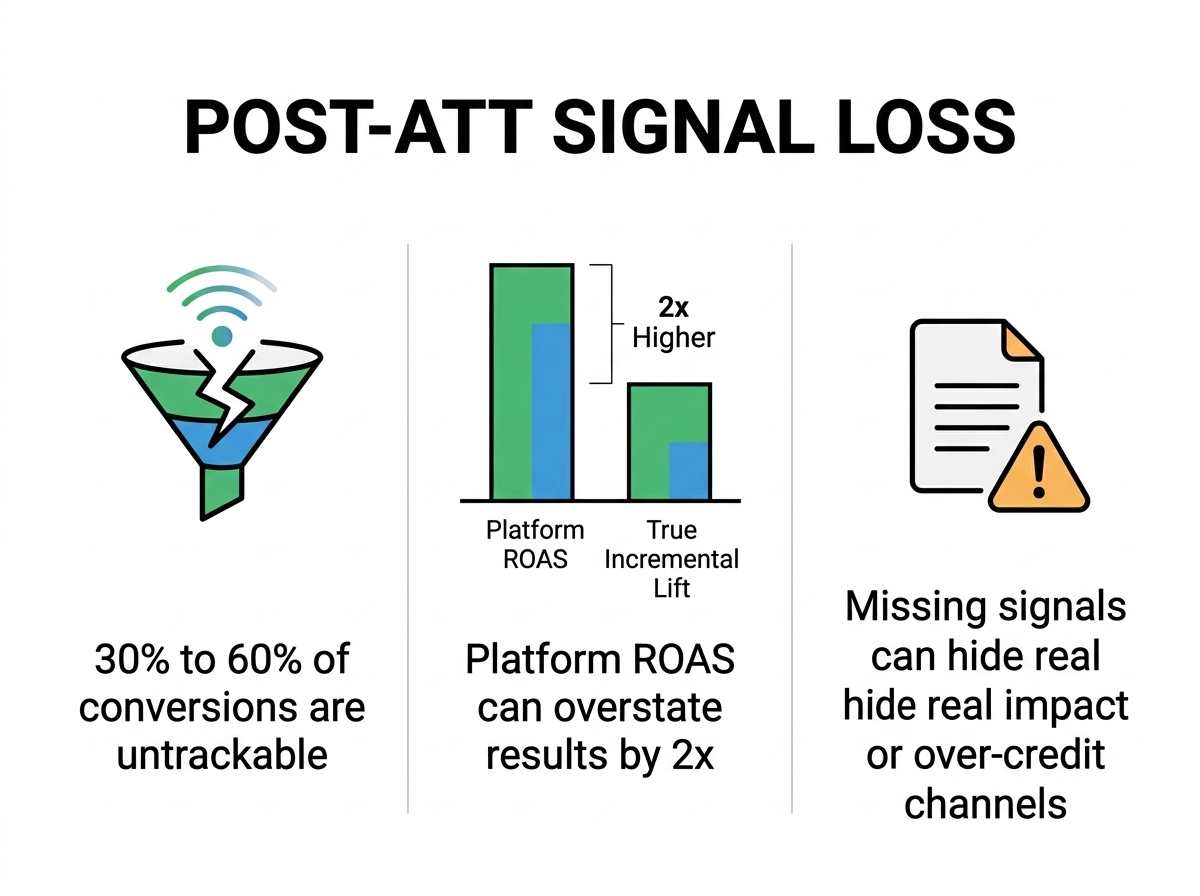
Post-ATT signal loss has left 30% to 60% of conversions untrackable in many markets. This data gap forces platforms to rely on modeled conversions, which often inflate performance significantly. For example, platform-reported ROAS frequently overstates results by 2x compared to true incremental lift. When you metrics to measure advertising effectiveness in isolation, you risk missing up to 60% of the actual marketing impact or over-crediting channels that did not drive the final decision.
Why last-click and MTA fail the CFO
Last-click attribution is particularly problematic for marketing strategists because it systematically overvalues bottom-funnel tactics. Retargeting and brand search often claim credit for 60% to 80% of conversions that would have happened organically regardless of the ad.
Meanwhile, multi-touch attribution faces its own set of hurdles:
These flaws mean that 78% of B2C executives now report failures in siloed attribution models. The industry is moving away from these granular trackers in favor of methods that respect privacy while providing more accurate business insights.
The shift toward econometrics and MMM
To regain accuracy, leading B2C brands are shifting toward marketing mix modeling. Unlike attribution, MMM is a top-down, privacy-safe framework that uses aggregate data to quantify the impact of every marketing dollar. It does not require user IDs, making it resilient against cookie deprecation and tracking opt-outs.
By using multivariable regression, MMM can perform a thorough base vs incremental sales analysis. Baseline sales, which typically account for 40% to 70% of total volume, are driven by brand equity, seasonality, and pricing. MMM isolates the true incremental lift generated by advertising while accounting for external factors like competitor activity or economic shifts.
The fundamental formula for this econometric approach is:
$Sales = Base + beta_{1}(Channel_{1}) + beta_{2}(Channel_{2}) + Seasonality + Macro Factors + Error$
This framework allows C-suite executives to understand the long-term effects of brand building and the diminishing returns of performance channels. It turns complex business data into clear, actionable budget decisions rather than just tracking clicks.
Validating results with lift testing
While MMM provides the strategic framework for budget allocation, measuring incrementality via lift testing provides the tactical ground truth. These experiments serve as a reality check for the model, ensuring that the predicted lift matches actual consumer behaviour.
Geo-experiments and conversion lift studies allow brands to compare a test group exposed to ads against a control group that is not. This identifies the lift directly attributable to the media spend. Integrating these experiments with econometrics vs attribution creates a resilient measurement stack that does not rely on individual user tracking.
Evolving beyond the dashboard
The "death of attribution" is not the death of measurement; it is an evolution toward more sophisticated, aggregate-based models. By 2025, over 50% of marketers are expected to shift toward MMM to navigate the permanent loss of digital signals. Attribution will remain in place to make inter-channel decisions.
To stop wasting up to 40% of your ad spend on ineffective channels, you must look beyond the platform dashboard. Transitioning to an econometric framework provides the clarity needed to make calculated decisions that drive genuine business growth. Explore how our mAI-driven media strategy can help you achieve over 90% prediction accuracy and eliminate ad waste.
Book a demo to see our marketing effectiveness solutions in action.
Get Marketing Analytics Insights
Monthly briefings on marketing mix modeling, budget optimisation and what's actually moving the needle for European brands.