Validate media mix model accuracy to cut B2C ad waste
Analytical Alley Team
Marketing Analytics Experts
Can you trust your marketing mix model to allocate millions in B2C ad spend? Many models fit historical data perfectly but fail to predict future sales. At Analytical Alley, our econometric validation...
Can you trust your marketing mix model to allocate millions in B2C ad spend? Many models fit historical data perfectly but fail to predict future sales. At Analytical Alley, our econometric validation framework ensures your investment decisions are backed by highly predictive, real-world data.
Why model fit is not enough
Many marketing leaders look at a high R-squared value and assume their model is accurate. This is a dangerous mistake. A model can fit historical data perfectly while failing completely when predicting future B2C purchase behavior.
To ensure your marketing mix modeling provides a reliable foundation for scaling budget, you must look beyond basic statistics. True validation requires a multi-pillar framework that combines backtesting, experiment-based calibration, and strict error diagnostics.
Backtesting and out-of-sample testing
Backtesting proves whether your model has captured stable causal relationships instead of just correlating random events. To execute this, your modeling partner should hide a portion of your historical data, train the model on the remaining data, and then ask the model to predict the results of the hidden period.
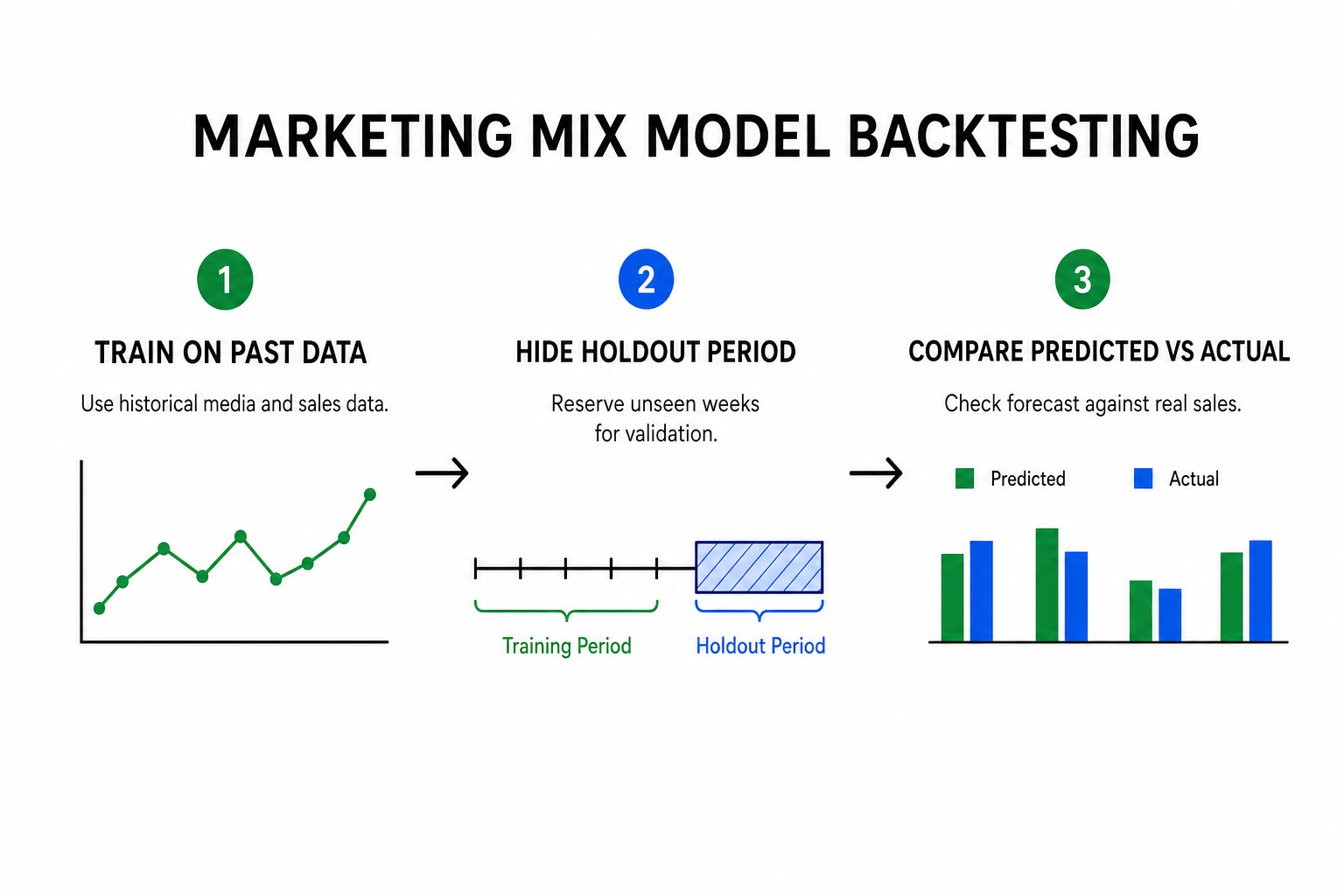
Key approaches to backtesting include:
This process prevents overfitting, which occurs when a model is too complex and mistakes random market fluctuations for meaningful trends.
Calibrating with incrementality and lift studies
Marketing mix modeling is exceptional at macro-level budget allocation, but it relies on historical correlations. To establish true causality, you must calibrate the model using real-world experiments. Comparing model estimates against the ground truth of incrementality tests helps you adjust model parameters and eliminate bias.
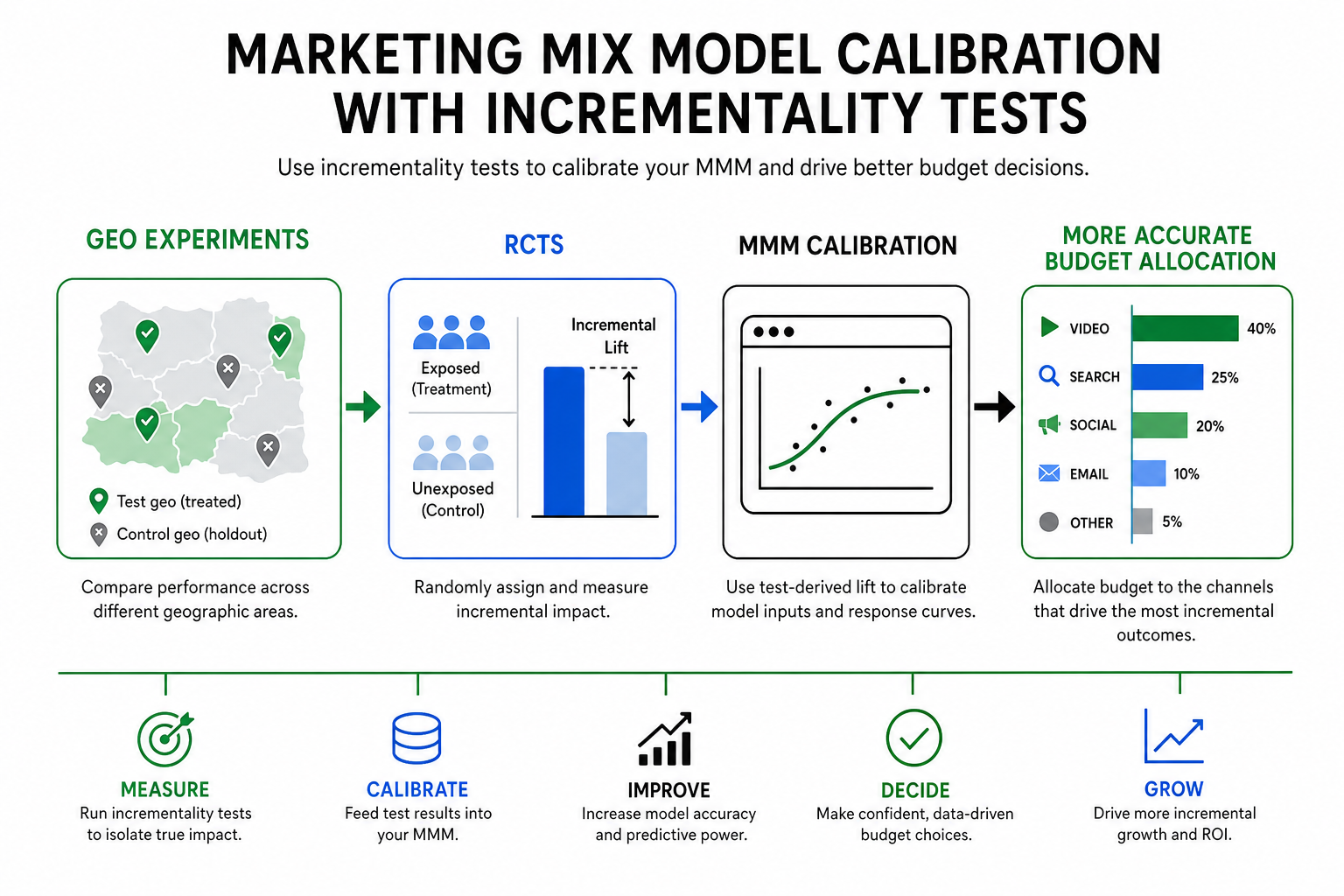
Deploying an integrated approach like MMM plus lift testing ensures your model does not over-attribute sales to channels that merely capture existing demand. This is particularly valuable when comparing brand lift studies vs MMM to balance immediate performance goals with long-term brand equity. For B2C brands managing multiple products or regions across Scandinavia, the Baltics, and wider Europe, combining these methods with hierarchical marketing mix modeling allows you to borrow statistical strength across regions, even where local experimental data is sparse.
Deciphering error and diagnostic metrics
A transparent validation process relies on specific statistical guardrails. You do not need a degree in econometrics to understand them, but you should expect your modeling partner to report these critical metrics:
While backtesting, experimental calibration, and error diagnostics are universally recognized as best practices, there is currently no single, globally standardized framework that automates all four pillars into a single consolidated metric. They must be managed as complementary tools to build a trustworthy model.
Key questions for your marketing and finance teams
Before you sign off on a major budget reallocation based on model recommendations, sit down with your team to review the methodology. Whether you are reviewing internal analytics or auditing an external partner, ask these key questions:
Clean data drives clean decisions
Validating your model is not a one-time task; it is an ongoing process of aligning mathematical predictions with real-world outcomes. By combining rigorous out-of-sample backtesting, regular lift experiments, and clear error metrics, you can confidently eliminate up to 40% of ad waste and direct your budget to the channels that actually drive growth.
Ready to build a validated, highly accurate model for your brand? Explore our tailored solutions for marketers and our auditing tools designed as solutions for C-suite executives to take control of your media measurement. To see how we deliver over 90% prediction accuracy, visit our marketing analytics resources today.
Get Marketing Analytics Insights
Monthly briefings on marketing mix modeling, budget optimisation and what's actually moving the needle for European brands.